


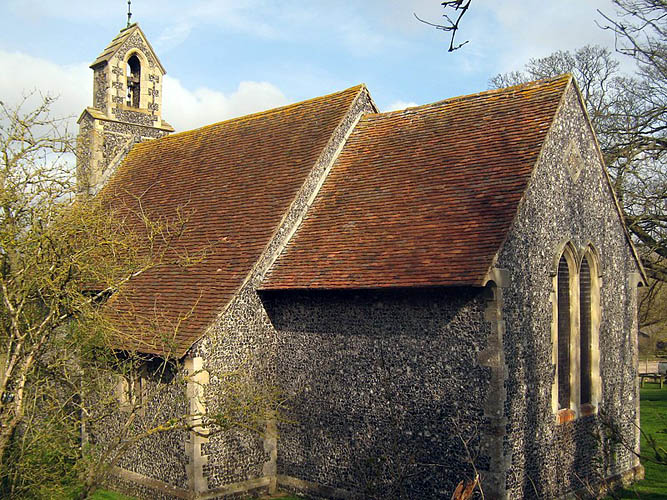
Photo: David Anstiss, Wikipedia CCA-SA
Details of the Bells
| Bell | Weight (most recent) |
Diameter | Note | Date | Founder | Canons | Retuned | ||
|---|---|---|---|---|---|---|---|---|---|
| ꓕ | Broken single bell | 1¼ cwt approx. | 18" | 1829 | Thomas Mears II, Whitechapel | Never |
ꓕ- Hung dead
Inscriptions on the Bells

Prior to 1829
| Bell | Date | Founder | Fate | |
|---|---|---|---|---|
| Single bell | Unknown | Recast / replaced 1829 |
History
| 1829 | The 12th century church was rebuilt by John Bell and the bell was recast by Thomas Mears II. At this time the church was dedicated to St Nicholas. | ||
| 1885 | The parish was merged with that of St Nicholas, Thanington. It was probably at about this time that the church was rededicated to St John the Baptist to avoid confusion. | ||
| 1887 | Stahlschmidt noted an 18 inch bell with the inscription 1829 at "Milton by Canterbury, St Nicholas. [2] | ||
| c1980 | In the early 1980s, services stopped at the church, it was closed and later taken over by Brett's (in whose grounds it stands) who repaired it and use it for storage. | ||
| 2010 | Photographs of the church show that the bell had broken just leaving the crown and the clapper hanging down. Photographs from 2006 show the bell intact, so this is the time window in which this will have happened. |
| [1] | The church, which is dedicated to St. Nicholas, consists of an isle and chancel, the whole of it so very small as to be called only a chapel. It has a small pinnacle of stone at the west end, in which there was till lately an aperture, in which hung one bell. There are no memorials in it, nor any remains worthy of notice.' ('History and Topographical Survey of the County of Kent: Volume 9 (Canterbury, 1800), pp. 28-32) |
| [2] | 1 bell. 18in. 1829' ('Church Bells of Kent, Stahlschmidt, J C L) |
| [3] | The parish church was totally rebuilt in 1829-30 by John Bell esq. ... The bell cote over the west end of the nave was rebuilt in the 19th century (it still has one bell in it), and Petrie shows an earlier bell cote, with a Dutch-gable-like top).' ('Historical and Archaeological Survey, Tim Tatton-Brown, 1993) |
Page updated: 2 January 2021