


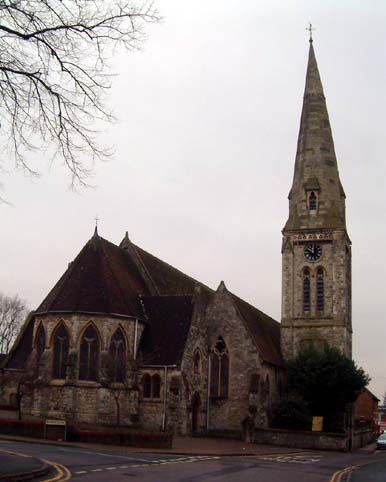
Photo: Dickon R Love, 25 Jan 2007
♫ Recording of the single bell.(Dickon R Love, 25 Jan 2007)
Details of the Bells
| Bell | Weight (most recent) * |
Diameter | Note | Date | Founder | Canons | Retuned | ||
|---|---|---|---|---|---|---|---|---|---|
| ꓕ | 1 | 8-2-17 | 35¾" | B | 1878 | Gillett & Bland, Croydon (230) | Never |
* Source of weight figures: G&J records
ꓕ- Hung dead
Inscriptions on the Bells

Prior to 1879
| Bell | Weight (most recent) |
Diameter | Date | Founder | Retuned | Fate | |
|---|---|---|---|---|---|---|---|
| 1 (of 2) | 1-2-11 | 19" | 1858 | Charles & George Mears | Never | Returned to G&J 29th Sept 1879. Not clear. Supplied at 1-2-10. | |
| 2 (of 2) | 2-3-12 | 23" | 1858 | Charles & George Mears | Never | Returned to G&J 29th Sept 1879. Not clear. Supplied at 2-3-10. |
History
| 1857 | The foundation stone of the new church was laid on Fri 1 May. [1] | ||
| 1858 | 2 bells were cast at Whitechapel and hung in a bell turret built during the first phase of church building. The church itself was consecrated on Mon 1 Feb. [2] | ||
| 1878 | A tower and spire were added to the church. A frame for 3 bells was installed. A clock bell was cast by Gillett & Bland (22nd July) and dispatched 12th Dec. | ||
| 1879 | A new clock was built for the tower and the clock bell was hung in a frame sitting on the 3 bell frame. Newspaper articles at the time suggested that the intention was for a ring of 8, of which this bell would be the tenor. Given the arrangement of the frame, there doesn't appear room for 8. The Gillett records suggest that 2 more bells were cast and then returned to the foundry (29 Sept) and subsequently sent to Rosario. The foundry received the two 1858 bells. [3] | ||
| 2007 | Belfry inspected by Dickon Love and Graham Heath who found the bell hung dead in its own frame sitting on a frame for 3 bells, never occupied. |
| [1] | THE NEW CHURCH OF ST. PHILIP, AT MAIDSTONE. The ceremony of laying the foundation stone of the new church, intended for the accommodation of the inhabitants if the Stone-street district, at Maidstone, took place on Friday last, the proceedings commencing with divine service at All Saints' church. |
| [2] | CONSECRATION OF ST. PHILIP'S CHURCH, MAIDSTONE. The interesting ceremony of consecrating the above church took place on Monday afternoon. |
| [3] | ST. PHILIP'S CHURCH, MAIDSTONE. The which clock has just been placed in the new tower of this church was formally started by the churchwardens and vicar (the Rev. H. Collie), on Friday, in the presence of a number of the parishioners. The clock and bell were manufactured by the well-known firm of Messrs. Gillett, Bland, and Co., of the Steam Clock Factory and Church Belt Foundry, Croydon. The clock strixes the hours upon a bell of Bcwt. 2qrs. I 7lbs., and shows the time upon three sft. Bin. skeleton iron dials, the figures and minutes being gilt. The wheels are all beautifully turned, cut, and polished, and :there is an engraved and silvered dial on the clock, for the purpose of adjusting the outer handsand taking observations. The pendulum is a compensating one, made of zinc and iron tubes, and beats 1 seconds of time with a cast iron cylindrical bob weighing 21- cwt. This is a considerable improvement on the ordinary wood rods, which are subject to considerable variations in summer and winter by dryness and moisture rendering their length (upon which much of the exactitude of timekeeping depends) uncertain, the variation of temperature having a contrary effect on zinc and iron, the rod is always kept the same length, and the centre of oscillation at the same point. The motive power is given to the clock by weights of about lOcwt., suspended from the iron barrels by steel wire lines carried over pulleys at the top of the tower. The escapement, which is one of the most important parts of the clock, is what is technically called a " double three-legged gravity." It is a most ingenious piece of mechanism, Having considerable advantages over the ordinary dead beat and other escapements commonly in use. It will work without oil, and is therefore better able to resist the effects of heat and cold, thus ensuring perfect timekeeping. The clock is so constructed that chimes can be added at any future time, when the other seven-bells have been provided to make up a peal, the present hour bell being the tenor. The four quarters will then be chimed upon four other bells, the same as at the Westminster Palace and St. Mary's Cambridge, and this part will be constructed on Gillett and Bland's new principle with moveable pins, so that the chimes can be adjusted to the greatest nicety. The clock, which is guaranteed not to vary more than five seconds per week, the first blow of the hour being the true time, contains all Messrs. Gillett, Bland, and Co.'s recent improvements. It is a splendid specimen of the horological art, and the entire work reflects great credit upon the manufacturers. The bell, which has been cast in Messrs. Gillett and Bland's own bell foundry, is a very fine-toned one, and has given general satisfaction. It is hung in a bell frame, constructed for a peal of eight. We may mention that Messrs. Gillett, Bland, and Co. were the manufacturers of the great clock and carillons at Manchester Town Hall, which is altogether the largest work of the kind that has ever been carried out.' ('Folkestone Express, Sandgate, Shorncliffe & Hythe Advertiser, 5 Apr 1879) |
Photos of the belfry

The frame sits on a frame for 3 bells side by side of pit widths 32", 28½", 34½". The last two of these can be seen above.
Photo: Dickon Love, 25 Jan 2007

The Gillett bell hanging dead in its own frame.
Photo: Dickon Love, 25 Jan 2007

Photo: Dickon Love, 25 Jan 2007
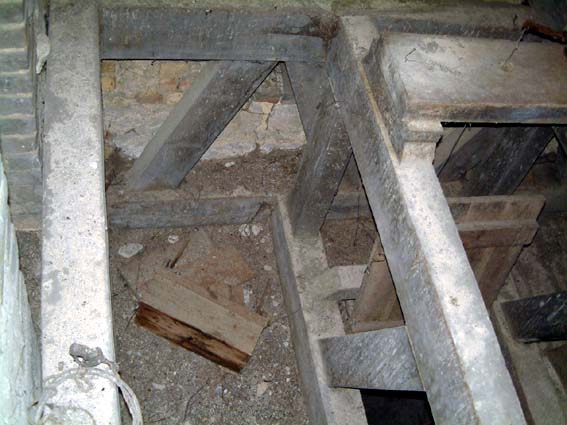
The 32" pit.
Photo: Dickon Love, 25 Jan 2007
Page updated: 28 March 2020