


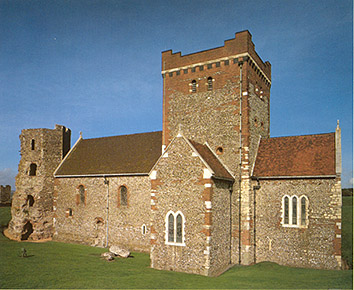
Photo: Dickon Love
Details of the Bells
| Bell | Weight (most recent) |
Diameter | Note | Date | Founder | Canons | Retuned | ||
|---|---|---|---|---|---|---|---|---|---|
| ҂ | 1 | 4½ cwt approx. | 28¾" | 1880 | John Warner & Sons | Never | |||
| ꓕ | Display bell | 2¼ cwt approx. | 20" | 1639 | John Clifton | Conventional | Never |
҂ - Hung for swing chiming
ꓕ- Hung dead
Inscriptions on the Bells

Bells thought to be in the tower in the 17th Cent.
| Bell | Weight (most recent) |
Diameter | Date | Founder | Retuned | Fate | |
|---|---|---|---|---|---|---|---|
| Treble | 9-2-14 | ?38" | 1345 | Unknown | Never | Sold c. 1690 | |
| 2nd | 12-2-0 | ?41" | Unknown | Never | Sold c. 1690 | ||
| 3rd | 16-0-0 | ?45" | Unknown | Never | Sold c. 1690 | ||
| 4th | 19-2-0 | ?48" | Unknown | Never | Sold c. 1690 | ||
| 5th | 26-3-0 | ?54" | 1381 | Stephen Norton | Never | Sold c. 1690 | |
| Tenor | 38-0-10 | ?60" | 1345 | Unknown | Never | Sold c. 1690 |
Prior to 1381
| Bell | Weight (most recent) |
Diameter | Date | Founder | Retuned | Fate | |
|---|---|---|---|---|---|---|---|
| 5th (of 6) | 26-3-0 | ?54" | 1345 | Unknown | Never | Recast 1381 |
History
| 1154 | Henry II reigned 1154 to 1189, during which tradition states that a ring of 5 was placed in the tower. | ||
| 1345 | Two new bells were cast at a cost of £15 18s. 5¼d. These weighed 4266lb and 1078lb. | ||
| 1381 | A bells described as the "great bell" (tenor) was cast by Stephen Norton. The bell was quoted on a brass inscription in the church in 1690 as being 30 cwt. However if there was already a bell of 4266lbs in the tower, this would more likely to have been the 5th. Tradition says that these bells were hung in the Pharos Tower although the central tower would have more room. | ||
| 1639 | Small bell cast by John Clifton, now disused and may have been the clock bell for the ancient clock now preserved in the Science Museum, Sth Kensington. It may have also been used as a bell to summon the garrison as it has a clapper suspended by a staple. | ||
| 1690 | The church was closed and the 6 bells sold. | ||
| 1861 | Church restored. The Clifton bell was used. | ||
| 1866 | Various newspaper articles made the claim that there were 5 bells which were sold (presumably when the church was closed) to St Thomas, Portsmouth (now cathedral), and augmented to 8, although the Dover five were first recast by Mears. None of this has been substantiated and later commentators have cast doubt on this account. [2] | ||
| 1880 | Bell cast by John Warner. | ||
| 1887 | J C L Stahschmidt discusses the bells in his book. He recounts the Portsmouth story, and that there was also a competing tradition that the bells actually went to St Margaret-at-Cliffe. He did not give credence to either story, but suggested that the bells were more likely to have been broken up and sent to Portsmouth Dockyard for casting purposes. He also gave a reference to the inscription on a 30 cwt bell from this set (likely the 5th) suggesting it was cast by Stephen Norton. [3] |
| [1] | In the description of the Surrenden Collection of manuscripts given by the Honorary Secretary in the preceding pages, mention is made, at p. 51, of a volume of Church Notes made by Sir Edward Dering, the first baronet, in conjunction with Philipot, about the year 1630. I have the gratification of communicating to the pages of 'Archaeologia Cantiana' four specimens from this volume. The outlines here given are exact copies of the originals, and fair samples of the interesting nature of the whole collection. It is only to be regretted that these records do not extend beyond thirty-two parishes. Many of the monuments, however, here recorded, have either wholly passed away, or have suffered great mutilation since Sir Edward's trickings were originally made. A large number of the heraldic memorials no longer exist, and in one instance, viz. that of the ancient church in Dover Castle, nothing remains but roofless crumbling walls. I have copied the Dover Brass in exact facsimile of the original, without that reduction in size which was found necessary to adapt the other three outlines for the pages of this work. Lyon, in his history of Dover Castle, gives a very rough and unsatisfactory sketch, more like that of an effigy than a brass, being without any of the decorations, canopy, etc. In describing it he appears to copy Dering's remarks verbatim, and had probably seen our manuscript; for, in another place he refers to Records "in possession of a gentleman whose ancestors filled a high office in Dover Castle." From which we may gather that he had been allowed access to the Surrenden muniments. He also gives the result of researches made in 1776, when the gravestone was exhumed, and displayed the extent of its original ornamentation, by the number and variety of its chasings. This stone, he says, was erroneously described by Weaver as of marble, whereas it was of a coarse grit, full of marine petrifactions. No doubt Weaver meant the favourite Bethersden marble, so extensively used in early periods in our county. So little regard was paid to these remains, that, although at a greater depth another large stone was found covering a slightly plastered grave, in which a few bones still remained, the soldiers were permitted to break up this venerable relic, and to use it for various purposes. The drawing will show the original condition of this beautiful brass, and is, I believe, the only record of it, in its perfect state, now extant. This Sir Robert Astone was son of Sir Robert of Ashton-under-Line, and filled many honourable offices, such as Admiral of the Narrow Seas, Justice of Ireland, Treasurer of the Exchequer, and Chamberlain to Edward III., by whom he was also appointed to be an Executor of his Will. At the foot of the tracing of the brass, Dering notes thus:--"On a flat gravestone, right before the high altar, this figure and inscription to Sr Robert Astone;" and below that, this note:--"The circumscription of the great bell here, and weighing 3000 lb. weight,--and which was the gift of that Sr Robert Astone,--hath every letter fair and curiously cast, and each crowned with a ducal crown. 'Dominus Robertus de Astone, miles, me fecit fieri, A. quarto R. Ricardi scdi G.' Lower than this, in small letters, was cast--'STEPHEN NORTON OF KENT ME MADE IN GOD INTENT.'' ('Archaeologia Cantiana, Volume 1, 1858) |
| [2] | CHURCH BELLS. - In the reign of Henry II. a peal of five bells was placed in the Pharos, within the walls of Dover Castle, which soon gained celebrity far and wide for the harmonious tones they were said to possess. In after years Prince George of Denmark, at the request of Sir George Rooke, had these bells removed from the Old Pharos at Dover and presented them to the citizens of Portmouth, who hung them, with considerable exultation and formality, in the town church, an edifice erected by Peter de Rupeleus in 1210 1220, and dedicated to St. Thomas á Becket. Three other bells were afterwards added, and subsequently, owing to some fancied defect in harmony of the tones of the eight, the five ancient ones were taken down and recast, as an inscription on them testifies, by one "Myers, or London." The townsmen soon learnt to love, or to say they loved, their bells, and there exists a tradition that in their sounds there is a weird tone peculiar to themselves, and widely different to all other peals, such as seamen in the olden times, when lying becalmed in their ships in the narrow strait which separates the coasts of England and France, have heard chiming out so strangely from the loftiest point of Dover Heights.' (' Dover Chronicle, Sat 17 Feb 1866) |
| [3] | This exceedingly interesting ancient church has, thanks to God, been lately, after some two centuries of desecration and neglect, restored to His service. Tradition states that in the seventeenth century there was here a ring of six bells, but whether they were in the church tower or in the old Roman Pharos, as Hasted states, is somewhat doubtful. Tradition is equally contradictory as to the fate of the said ring. One authority states that Prince George of Denmark, at the intercession of Admiral Rooke, caused them to be removed to Portsmouth and placed in the tower of St. Thomas's Church there. Another authority slates that the order for removal to Portsmouth was never carried out, but that the bells went to St. Margaret at Cliffe. Neither of these traditions is, I think, correct ; the date of the present ring at Portsmouth disproves the one, and the fact that St. Margaret at Cliffe possesses only one bell, and that of earlier date than the supposed transfer, militates equally against the other. The element of truth lying at the bottom of all this is, I think, that the bells were broken up and the metal sent to Portsmouth Dockyard for casting purposes. We have, however, in the Surrenden MSS., a piece of information as to one of these bells which is perfectly trustworthy, as being within the personal knowledge of the narrator. Sir Edward Deering. It is given as follows in "Arch. Cant.," vol. i. It appears that there was at that time (1630) in this church a brass (of which a sketch is given) to Sir Robert Astone, and the following note is added by Sir Edward: "The circumscription of the great bell heere and weighing 3000 lb. weight, and which was the gift of that Sir Robert Astone, hath every letter fayre and curiously cast, and each crowned with a ducal crown 'Dominus Robertus de Astone Miles me fecit fieri A° quarto R. Ricardi sedi G.' Lower than this in small letters was cast " ' Stepne Norton of Kent Me made in god intent.'" It is to be noted that these last two lines appear on a bell now at Chiselborough in Somerset, cast by the said Stephen Norton, and that on the only two other specimens of his workmanship known now to exist, viz., those at Snave and Holy Cross, Canterbury, the inscriptions are in very handsome crowned capitals.' ('"Church Bells of Kent", J C L Stahlschmidt, 1887) |
Gallery
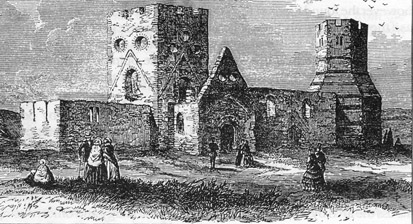
The church in 1858.
Photo: David Cawley collection
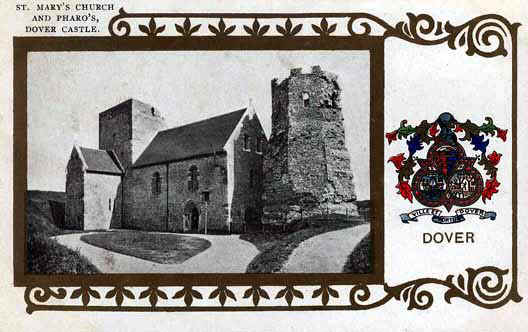
Also taken before 1880 when the top of the tower was built.
Photo: David Cawley collection
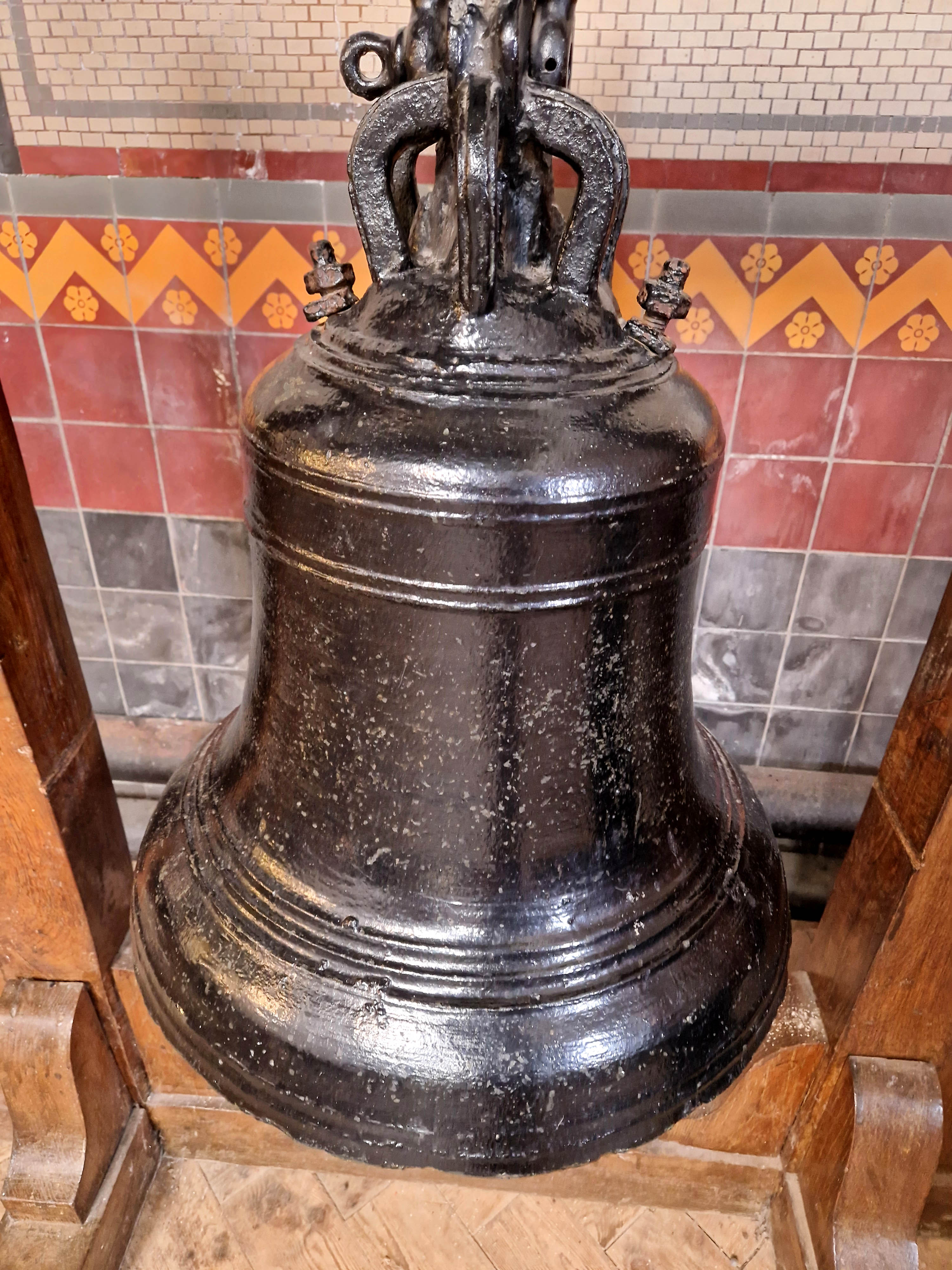
The disused bell on display in the church.
Photo: Jeremy Clitheroe, July 2024
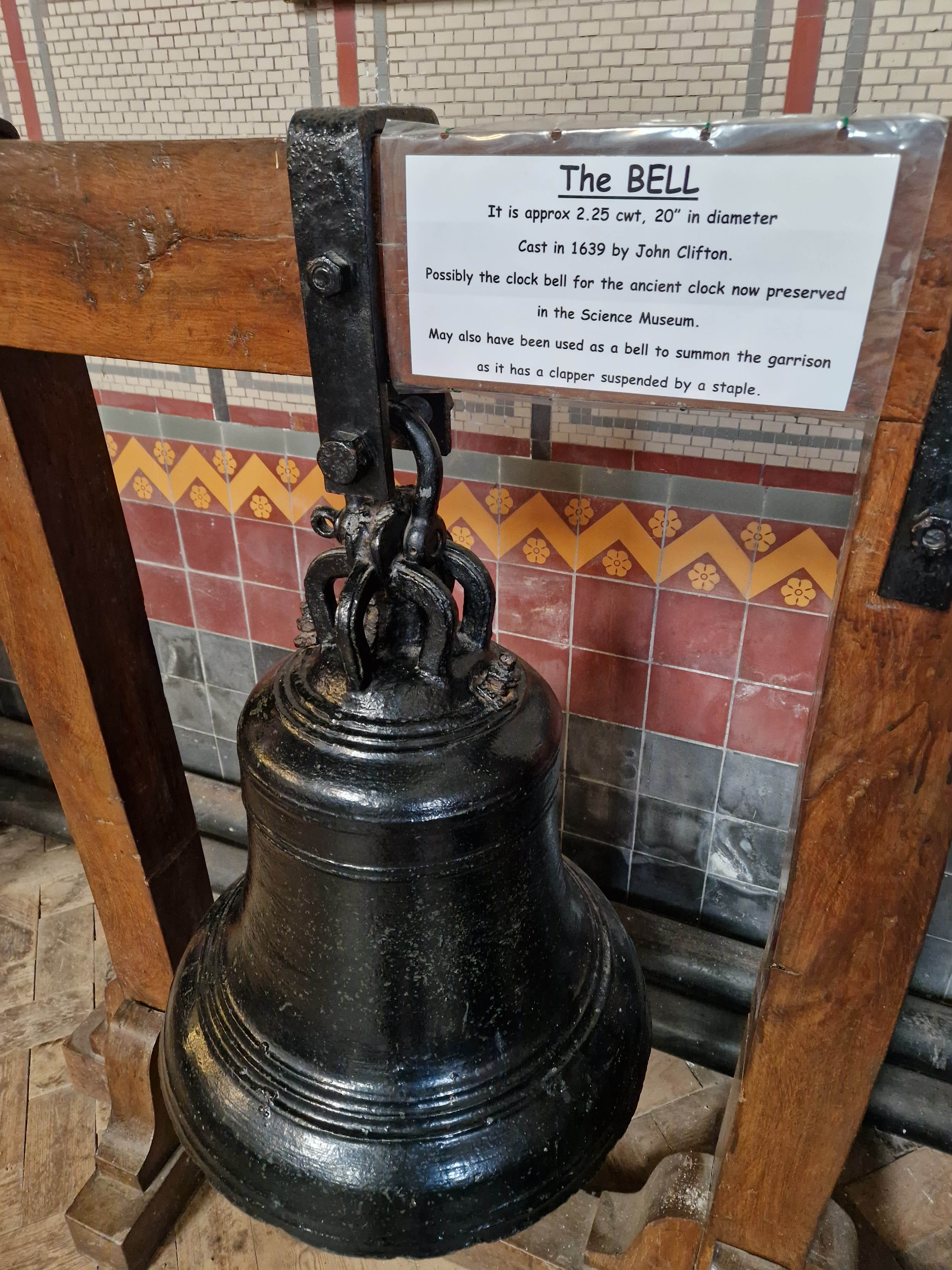
The disused bell on display in the church.
Photo: Jeremy Clitheroe, July 2024
Page updated: 1 April 2016