


Photo: Dickon R Love, 11 Sept 2020
Details of the Bells
| Bell | Weight (most recent) |
Diameter | Note | Date | Founder | Canons | Retuned | ||
|---|---|---|---|---|---|---|---|---|---|
| ® | Treble | 2¾ cwt approx | 23" | G♯ | 18th cent | Unknown | Removed | Never | |
| ® | 2 | 3¼ cwt approx | 25⅛" | F♯ | 1894 | Samuel B. Goslin, Bishopsgate | Flat | Never | |
| ® | 3 | 4¼ cwt approx | 27½" | E | 1893 | Samuel B. Goslin, Bishopsgate | Flat | Never | |
| ® | 4 | 3¾ cwt approx | 28½" | D♯ | 1692 | John Hodson, Whitechapel | Conventional | Never | |
| ® | 5 | 5¼ cwt approx | 30½" | C♯ | 15th cent | Unknown | Conventional | Never | |
| ® | Tenor | 7½ cwt approx | 33¹⁵⁄₁₆" | B | 1616 | Joseph Hatch, Ulcombe, Kent | Conventional | Never |
® - Hung for full circle ringing
Bellframes
| Frame | Bells | Year | Maker | Material | Truss(es) | Local Layout |
|
|---|---|---|---|---|---|---|---|
| 1 | All bells | 1888 | Samuel B. Goslin, Bishopsgate | Timber | 6.A

|
6.1

|
Inscriptions on the Bells
How the bells are tuned

History
| c1450 | Present 5th cast. | ||
| 1552 | Record of 4 bells in the tower. [1] | ||
| 1616 | Present tenor cast. | ||
| 1692 | Present 3rd cast. | ||
| c1750 | A clock bell was cast for All Saints' church. This is destined to become the treble of the ring of 6 at St Alphege. | ||
| 1800 | Edward Hasted noted 3 bells in the square tower steeple at the west end of the north aisle [2] | ||
| 1888 | A major restoration of the church took place as it was in very poor condition. The old roof of the tower was removed and a new timber belfry was constructed in the form we see today. The old bellframe was removed and a new frame for 6 bells was constructed to allow future augmentation. The existing 3 bells were hung in the back 3 pits. [3] | ||
| 1890 | Further alternations to the church took place during the year and a thanksgiving service was held on Sun 9 Nov 1890. The 3 bells were noted. The parish also openly spoke about possessing a bell from the neighbouring All Saints church. [4] | ||
| 1892 | The Rector and the Hon Curate both offered to purchase bells provided the parish pay for their hanging. Together with the bell from All Saints church, this would create the ring of 6. [5] | ||
| 1893 | A bell was cast by Samuel Goslin being one of the two promised by the Rector and Hon Curate (probably the former given the inscription upon it). It is not clear whether this bell was hung at this stage, but seems doubtful. | ||
| ❸→❻ | 1894 | The other bell promised was cast by Samuel Goslin and the new ring of six was complete using this, the bell cast the year before and the clock bell from All Saints' church. The bells were rung from the ground floor. They were dedicated on 26th September, [6] [7] | |
| 1931 | The bells were rehung by Alfred Bowell. The ringing chamber was moved to the first floor. [8] | ||
| 1957 | The bells were overhauled by the King's School Society of Ringers and ringing resumed after a silence of some 20 years. | ||
| 1969 | The bells were overhauled by the KCACR and the tower was completely cleared of vast quantities of lumber. | ||
| 1982 | The church was declared redundant (7th April). | ||
| 1983 | The church became the Urban Studies Centre. Some years later the name changed to Canterbury Environment Centre. | ||
| 1992 | Ringing resumed from the intermediate chamber, the old ringing chamber having become an office. | ||
| 2002 | The late Nicholas Davies (who learned to ring here) wrote to Dickon Love to explain how he estimated the bell weights that are quoted today. [9] | ||
| 2007 | The church was taken over by King's School and turned into a shop. | ||
| 2018 | The ringing chamber was returned to the first floor, co-existing with the office. |
| [1] | Item one bell for the dede peple.Item in the Steple iiij bells and a wagerell bell.' ('Edwardian Inventory, 1552) |
| [2] | ST. ALPHAGE church is situated in the north part of the city, on the west side of Palace-street; it is a large handsome building, consisting of two isles and two chancels, having a square tower steeple at the west end of the north isle, in which are three bells.' ('The history and topographical survey of the county of Kent, second edition, volume 11 1800, Edward Hasted) |
| [3] | ST. ALPHEGE CHURCH. RE-OPENING CEREMONY. On Monday last, St. Alphege Church which has been undergoing very considerable alterations during the past year was re-opened by his Grace the Archbishop of Canterbury. [...] The Tower is singular in its oblong plan, but it is very likely that it was made wider in the 13th century, while the other dimensions and probably the old walls, as far as possible, were retained. Its walls are built in a very indifferent manner, as such is too frequently the case in Norman work, and quite accounts for the serious settlements which made it necessary to remove the upper or belfry stage in the 17th century. The existing lancet window is of the 13th century date, as is also an upper one recently taken down. A very poor bell-chamber with a tiled roof was the termination before this pulling down took place, and it was in our opinion quite unworthy of reproduction. It being most desirable to retain the old walls, even though not strong enough to bear a mass of new heavy masonry, the new belfry stage with the bell cage is designed to be in timber construction, and supported on the old walls covered on the outside with tiles, thus giving the picturesque and characteristic treatment often found in the County of Kent. Some idea may be formed from this narrative of Mr. Carpenter as to what has been done to the church.' ('Kentish Gazette, Sat 13 Oct 1888) |
| [4] | THE RESTORATION OF ST. ALPHEGE CHURCH. Thanksgiving services to celebrate the restoration of St. Alphege Church were held on Sunday morning and evening. [...] With respect to hanging the bells, this item includes new framework, as the old was not fit to use again, there will be room in the tower for 6 bells and care has been taken that if the parishioners wish to add the other 3 bells, the present ones will not have to be disarranged. The 3 bells of St. Alphege date from 1616 and 1692, the one at All Saints' about 1590. Annexed is a list of subscriptions already received, and it is to be hoped that those who helped us before, will come forward again, so that the Church Restoration may be complete. God has blessed our efforts in the past, let each one of us see what we can do to raise this £150 and to complete the restoration, and wipe away the reproach from our church. It is proposed to place a tablet in the tower, in memory of our good friend, the late Bishop of Dover. It has been well known, to all who have taken an interest in the church, how anxious the good bishop was to see S. Alphege completely restored.' ('Kentish Gazette, Tues 11 Nov 1890) |
| [5] | ST. ALPHEGE AND ALL SAINTS. The Chairman said he was ashamed to tell them that before hardly a year had passed it had been found necessary to strengthen the tower. The builder blamed the architect. Mr. Young: He did not go up the tower at all. The Chairman said that the bells had been placed just contrary to the position they should have been, with the result that they had had to strengthen the tower, which cost them £10. They had some money in hand on the Tower Fund which would pay for the work. [...] The Chairman said there was another matter he had to bring forward. They had a splendid bell at All Saints church doing nothing. He thought it would be a good thing to have it removed to St. Alphege Church. After some discussion it was decided on the motion of Mr. Parry, seconded by Mr. Young, to let the matter stand over for a time, the Rector, in the meanwhile to obtain estimates of the cost of removal and of one or two additional ones.' ('Kentish Gazette, Sat 23 Apr 1892) |
| [6] | ST. ALPHEGE. The Chairman said he had another matter to bring forward. At present they had only four bells at the church, but by an arrangement between himself and the Rev. H. Heward (Curate), they would give two more to the parish on condition that the parishioners would raise the sum of £19 10s., the cost of hanging them.' ('Kentish Gazette, Sat 31 Mar 1894) |
| [7] | DEDICATION OF ST. ALPHEGE BELLS. [...] Additional interest was attached to the event by the dedication of three new bells, two of which have been kindly presented by the respected Rector (the Rev. T. G. Crosse) and the Hon. Curate, the Rev. H Heward. The parishioners of St. Alphege now possess a peal of six bells, and we may state the the only expense to the parishioners is the cost of hanging, together with the chiming apparatus. This, it is estimated, will be about £30, towards which a further sum of about £8 is still required. The parishioners have shown their deep appreciation of the kindness of the Rector and Hon. Curate by getting together, in the parish, a sum of no less than £16. The prayers were intoned by the Rev. H. Harward, and the lesson read by the Rector and the Rev. W. Eviel (vicar of St. Dunstans). The Rev. C. de Cantaret of Tulse Hill, and late Curate of St. Dunstans Canterbury occupied the pulpit, and gave an appropriate address from Genesis, 2nd chapter, 15th verse. Stainer's harvest anthem, "Lo, summer comes again," was creditably rendered by the choir, Mr. J .E. Reid (organist and choirmaster) ably presiding at the organ. After the address the bells were dedicated, and a short peal was rung, while another of 720 was rung at the conclusion of the service. The services will be continued on Sunday, the Bishop of Dover occupying the pulpit in the evening.' ('Kentish Gazette, Sat 29 Sept 1894) |
| [8] | To new gudgeons and bearings and overhauling the six bells £60. Extra 2 new stocks & ironwork £3. Total £63. Paid by money orders 1 May 1931.' ('Bowell records, 31st Mar 1931) |
| [9] | At around about the time that I was learning to ring and taking an interest in bell archaeology, I was also studying in Canterbury for both elementary and additional maths at O-level. There were some odd copies of pre-war Ringing Worlds in the tower and in one of these I found an article giving a mathematical formula for calculating the approximate weight of a bell from its diameter and a number of proportional constants. I believe it was written by one of the bellhangers and can't remember all the ins and outs of how it was done, but I do remember that you had to deduct 1cwt per ton of bell for canons removed. I had a lot of fun and manually calculated a large number of weights of Kent bells from diameters as in Stahlschmidt plus any others that I had in my records; it was all done on a slide rule or using log tables and a basic computer would have given me the results in a fraction of the time. I still have a notebok from this period which shows that by this method I calculated the St Alphege weights as: 2.3.3 2.3.19 4.2.21 4.0.11 5.2.13 and 7.3.13. Later on I refined this system (at the suggestion of my maths teacher) by taking a bell (or bells) of known exact weight and note for a particular founder and doing the calculation backwards to give a varying constant for each founder which would relate to his bells' profiles and guage of thickness. By this time I had some more accurate measurements to go on and I decided to round the calculated weights to the nearest quarter. I don't have my revised calculations for St Alphege, but I do have a note that the approximate weights of the bells were recorded in the ringing chamber as: 2.3.0 3.1.0 4.1.0 3.3.0 5.1.0 and 7.2.0 (the weight that is normally given today).' ('Email from Nicholas Davies to Dickon Love, 2 Jul 2002) |
Videos
Part of a peal of Surprise Minor rung on 8th March 2026.
Gallery
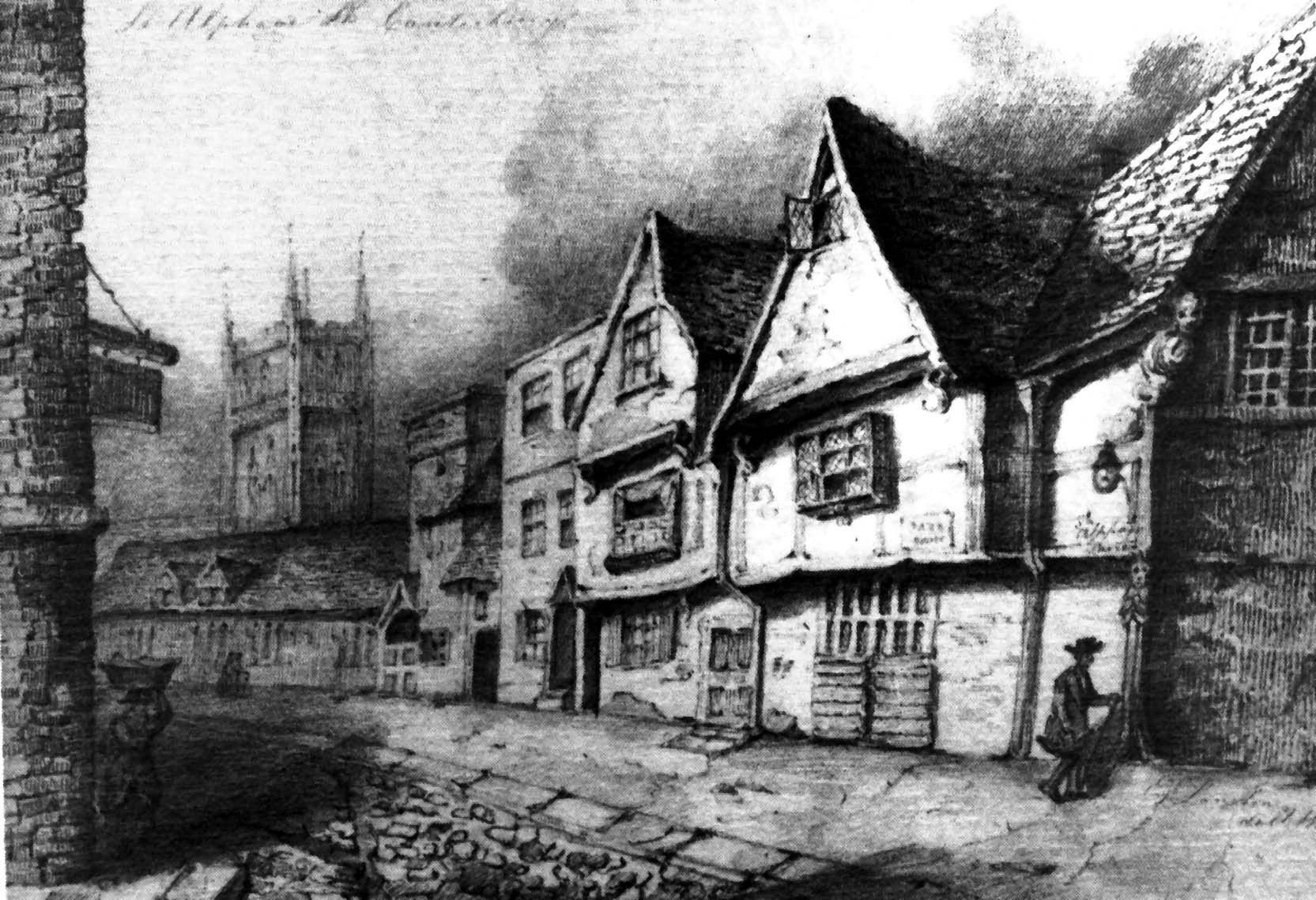
The church as it appeared in c.1826 (E J Langdon). Canterbury Cathedral is in the background.
Photo: David Cawley collection.
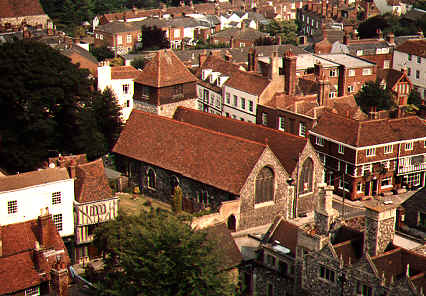
The church photographed from the top of the Arundel Tower of Canterbury Cathedral.
Photo: Dickon R Love, c.1990

The staircase to the ringing room, which was restored to use in 2020.
Photo: Dickon R Love, 11 Sept 2020

The ringing room just after it moved back to the 1st floor office.
Photo: Simon Adams, 2018
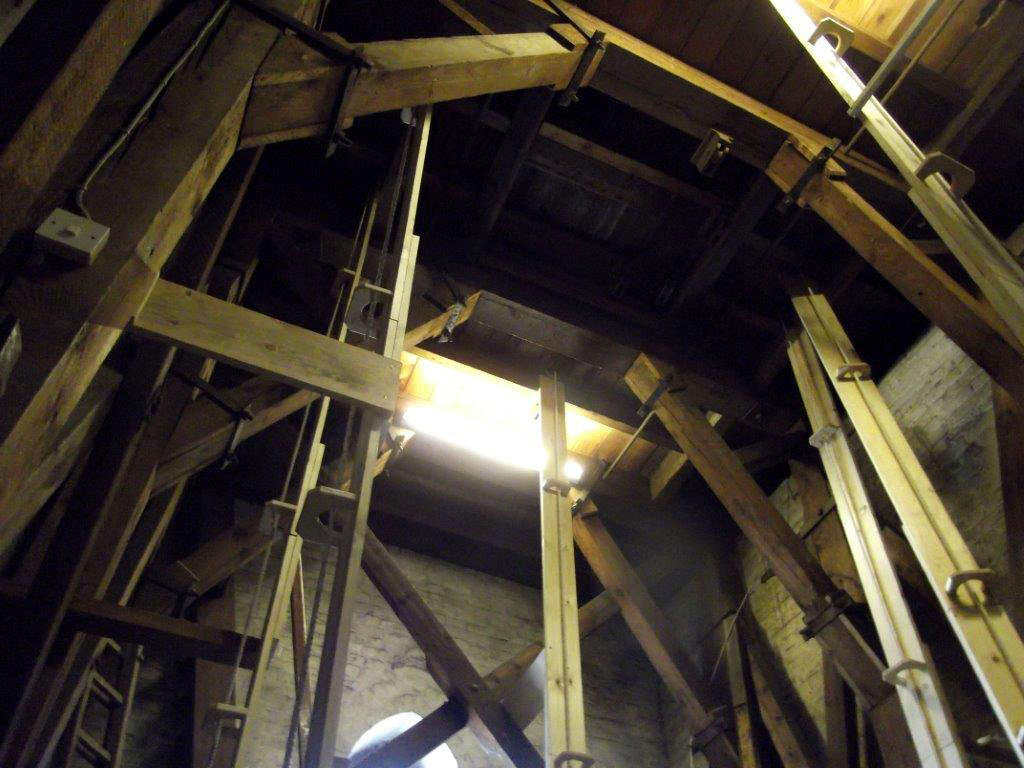
Goslin's timberwork in the intermediate chamber (for some time used as the ringing room).
Photo: Simon Adams, 2018

The ringing room in 2026.
Photo: Dickon R Love, 6 Mar 2026

The ringing room in 2026.
Photo: Dickon R Love, 6 Mar 2026
Peal boards
Timber Performance Board dated approx. 1896
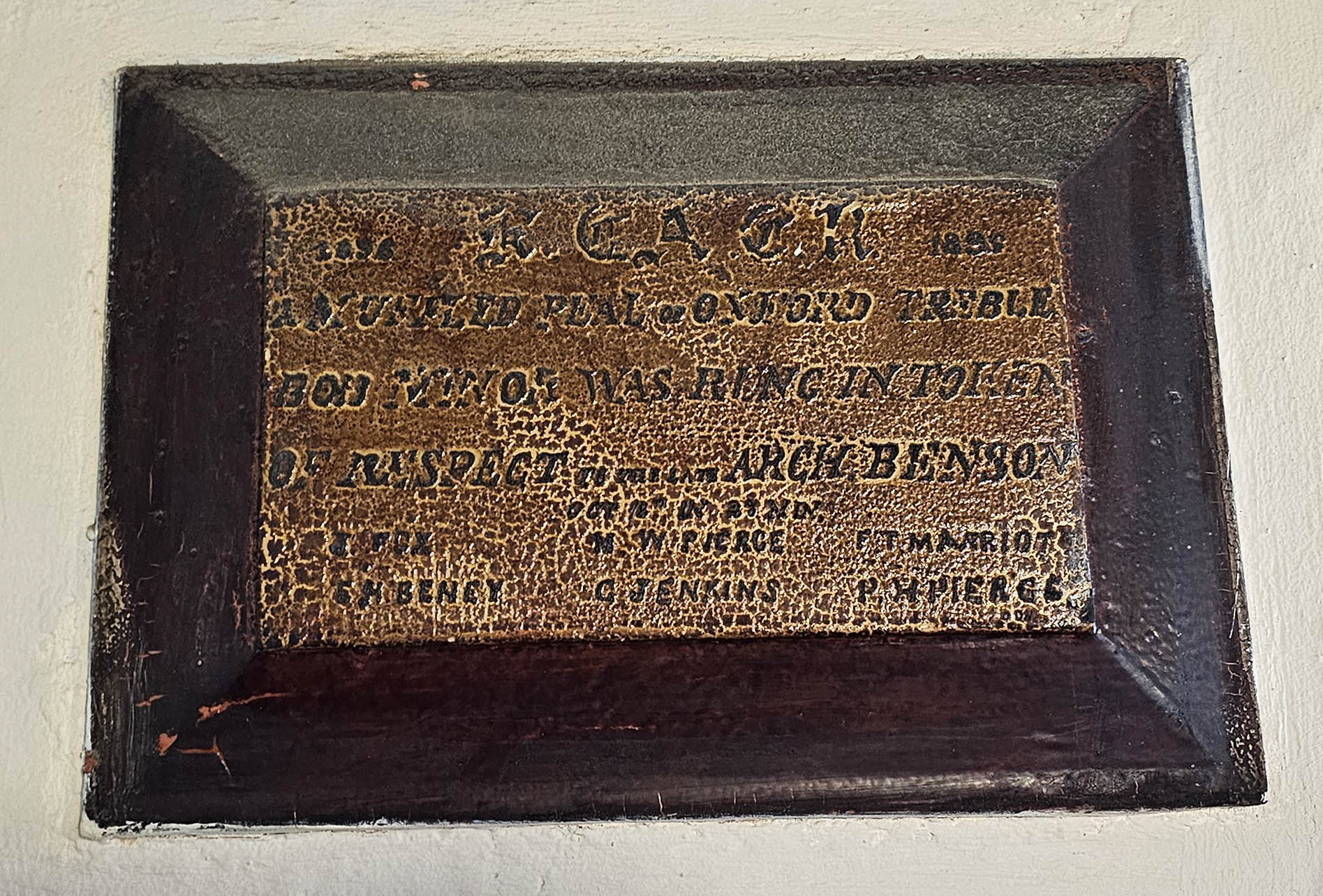
Photo: Dickon R Love, 8 March 2026
Stone Performance Board dated approx. 1897
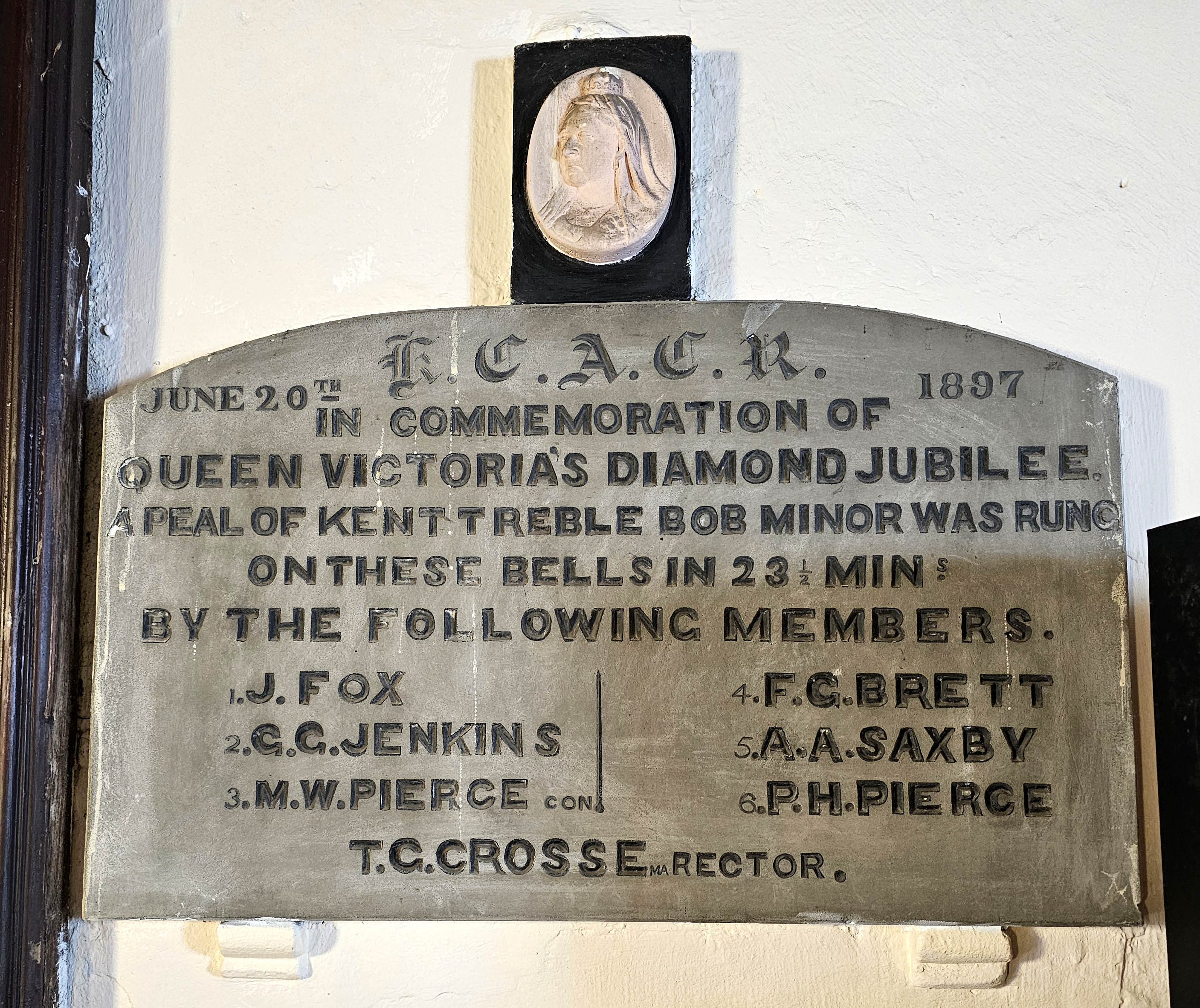
Photo: Dickon R Love, 8 March 2026
Ceramic Memorial Board dated approx. 1901
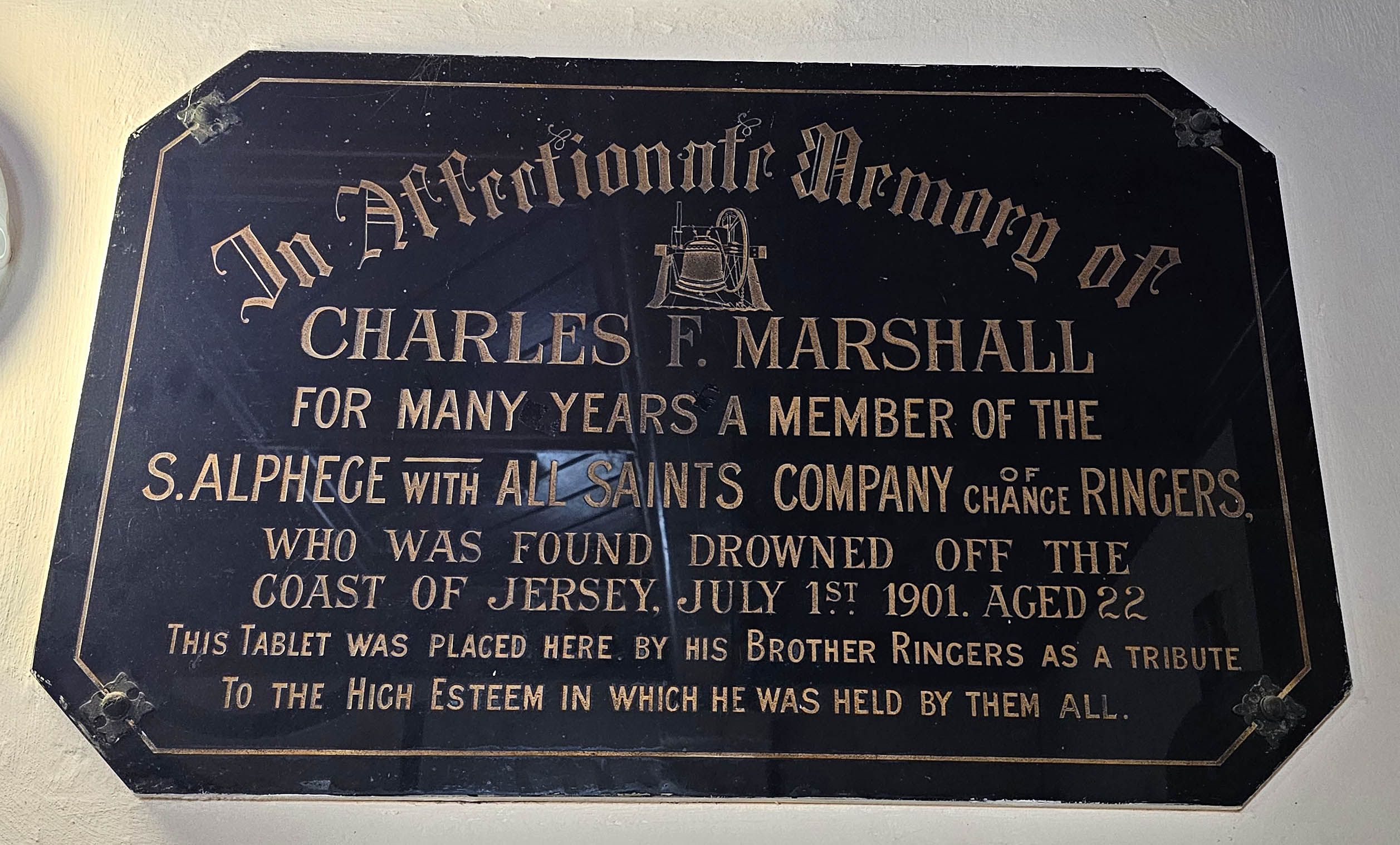
Photo: Dickon R Love, 8 March 2026
Timber Performance Board dated approx. 1902

Photo: Dickon R Love, 8 March 2026
Page updated: 25 September 2020