


Photo: Dickon Love, Apr 2013
♫ An extract from a peal of Stedman Triples, which includes Queens.(Phillip R J Barnes, 31 Dec 2015)
| Bell | Weight (most recent) |
Diameter | Note | Date | Founder | Canons | Retuned | ||
|---|---|---|---|---|---|---|---|---|---|
| ® | Treble | 5-0-24 | 28¼" | F | 1950 | Gillett & Johnston, Croydon (6846) | Flat | Never | |
| ® | 2 | 5-1-4 | 28⅝" | E | 1950 | Gillett & Johnston, Croydon (6847) | Flat | Never | |
| ® | 3 | 5-2-25 | 30" | D | 1950 | Gillett & Johnston, Croydon (6848) | Flat | Never | |
| ® | 4 | 6-1-8 | 31½" | C | 1950 | Gillett & Johnston, Croydon (6849) | Flat | Never | |
| ® | 5 | 7-2-25 | 34⁹⁄₁₆" | B♭ | 1950 | Gillett & Johnston, Croydon (6850) | Flat | Never | |
| ® | 6 | 9-0-17 | 36¹¹⁄₁₆" | A | 1950 | Gillett & Johnston, Croydon (6851) | Flat | Never | |
| ® | 7 | 12-3-19 | 40½" | G | 1950 | Gillett & Johnston, Croydon (6852) | Flat | Never | |
| ® | Tenor | 16-2-8 | 45" | F | 1950 | Gillett & Johnston, Croydon (6853) | Flat | Never | |
| ꓕ | Clock | 3-0-24 | 24¹³⁄₁₆" | F | 1950 | Gillett & Johnston, Croydon (6979) | Flat | Never |
® - Hung for full circle ringing
ꓕ- Hung dead
| Position | Frame | Bells | Year | Maker | Material | Truss(es) | Local Layout |
|
|---|---|---|---|---|---|---|---|---|
| Main tier | 1 | Ring of 8 | 1951 | Gillett & Johnston, Croydon | Cast iron | 8.3.A.m

|
8.3

|
|
| Belfry ceiling | 2 | Clock |


| Bell | Weight (most recent) |
(As received 1930) |
Diameter | Note | Date | Founder | Retuned | Fate | |
|---|---|---|---|---|---|---|---|---|---|
| Treble (of 8) | 5-0-17 | 5-1-10 | 29" | F | 1773 | Thomas Janaway | 1930 Mears & Stainbank | Destroyed 1941 | |
| 2nd (of 8) | 5-1-18 | 5-2-13 | 29¾" | E | 1773 | Thomas Janaway | 1930 Mears & Stainbank | Destroyed 1941 | |
| 3rd (of 8) | 6-0-24 | 6-1-16 | 32" | D | 1773 | Thomas Janaway | 1930 Mears & Stainbank | Destroyed 1941 | |
| 4th (of 8) | 8-0-20 | 8-1-5 | 34" | C | 1773 | Thomas Janaway | 1930 Mears & Stainbank | Destroyed 1941 | |
| 5th (of 8) | 8-3-6 | 9-1-16 | 37¾" | B♭ | 1773 | Thomas Janaway | 1930 Mears & Stainbank | Destroyed 1941 | |
| 6th (of 8) | 10-0-7 | 10-3-0 | 38¾" | A | 1773 | Thomas Janaway | 1930 Mears & Stainbank | Destroyed 1941 | |
| 7th (of 8) | 12-0-14 | 12-1-27 | 41½" | G | 1773 | Thomas Janaway | 1930 Mears & Stainbank | Destroyed 1941 | |
| Tenor (of 8) | 17-1-14 | 18-0-19 | 47¼" | F | 1773 | Thomas Janaway | 1930 Mears & Stainbank | Destroyed 1941 | |
| Sanctus | 2-3-14 | 1777 | Thomas Janaway | Never | Destroyed 1941 |

| 1552 | Record of 4 bells in the tower. [1] | ||
| New ❽ | 1773 | By this time there was a ring of 5 which were recast with 3 bells added to form a ring of 8 by Thomas Janaway. The work cost £250 according to the Parish Vestry Book. | |
| 1777 | Sanctus bell cast by Thomas Janaway. This was hung in a small hut on the tower roof. | ||
| 1814 | A peal was rung which was noted to be the first since the bells were rehung by Mr J Woodling of Whitechapel. | ||
| 1817 | 15th Jan | A half-muffled peal of Grandsire Triples was rung on the bells on 15 Jan by the Society of Bromley Youths in memory of William Chapman, a ringer here for 43 years. This was claimed as "Being the first Dumb Peal of this kind ever rang in this kingdom". | |
| 1878 | The bells were provided with new fittings by G R Banks of Kennington. | ||
| 1902 | Bells rehung and quarter turned by Gillett & Johnston. [2] | ||
| 1930 | Bells retuned and rehung in a new frame by Mears & Stainbank. They were rung again at a special service on Sat 15 Nov conducted by the Vicar. [3] [4] | ||
| ❽→꙰ | 1941 | Church bombed in World War II and the bells were destroyed. | |
| 1948 | -1957 | New church built. | |
| New ❽ | 1950 | New ring of bells and Sanctus cast by Gillett & Johnston. | |
| 1951 | Bells hung in a new frame. They were dedicated by the R't Rev'd F. S. Guy Warman D.D., L.L.D. on 15th September | ||
| 1957 | New church consecrated on 14 Dec. | ||
| 2006 | A major overhaul of the bells took place by Whitechapel. |
| [1] | Item iiij greale bells suted in the steple, one sants bell and iij lytle sacrying bells, one hand bell.' ('Edwardian Inventory) |
| [2] | For the first time for some weeks the bells of the Parish Church pealed merrily on Sunday morning, and at intervals throughout the day, to celebrate the recurrence of the Easter Festive. They have been renovated and re-hung several important alterations having been carried out in the belfry, and there is no doubt that their tone has been greatly improved thereby. ... The number of communicants during the day was 377; and the offertory, which was in aid of the special fund or defraying the cost of repairing the bells amounted to £31 3s. 5d.' ('Bromley and West Kent Telegraph, Sat 5 Apr 1902) |
| [3] | BROMLEY CHURCH BELLS. REMOVED FOR RE-TUNING. After 157 years of service the bells of Bromley Parish Church have been removed to be retuned, re-clappered and re-hung. Well over 200 peals of 5,000 changer each have been given on the bells, rung as they have been at all the great Church festivals, at coronation times, and on the occasion of victories on land and sea. Of late years, however, the bells have got more and more out of tune, and a thorough restoration is overdue. The cost will be £250, of which £210 has already been provided by legacy and subscription. The bellringers have undertaken to raise the remaining £40. In 1772 £300 was raised for the making of these bells - surely after more than a century and a half of service there should not be much difficulty in raising £40 to restore them. An expert opinion as to the condition of the bells has been obtained from Messrs. Mears and Stainbank, who are the successors in business of Thaomes Hanaway, who cast the bells in 1773. They report that thought the bells are out of tune their tone is not so poor as to necessitate recasting, and that if they are properly corrected in tune under a tuning machine they would sound a really good peal. Certain repairs and renewals are suggested to the fittings and the insertion of tie bolts to tighten up the bell frame is recommended. The work suggested is stated to be the minimum necessary to make a really satisfactory and lasting restoration. The steeplekeeper and leader of the ringers, Mr. I. Emery, has been connected with the belfry for over 40 years, and has himself rung more than 50 peals of over 5,000 changes each on the bells. He rang his first 120 changes on the Bromley bells on the occasion of Queen Victoria’s Jubilee in 1887. In 1910 Mr. Emery was invited to join the Society of Bromley Youths, the local band of ringers, and in 1887 was elected leader in succession to Mr. E. D. Durling. Altogether Mr. Emery has rung 338 peals in various parts of the country. The Last Peal. The last occasion on which a peal was rung at Bromely was when 5,040 Grandsire Triple were rung, conducted by Mr Emery, on May 29th, 1929, 156th anniversary of the dedication of the bells. It is hoped that the bells will be restored by Civic Sunday, November 16th. Mr. George Huxley, the deputy leader of the ringers, has been connected with the tower for over 50 years, and hopes yet to ring another peal with the new bells. Bells have probably hung in the tower since its first construction. An Inventory of church good dawn up in 1553 notes: “Item, iii greate Belles, seeted in the steple, one Sants bell, and iii little sacrying bells and one hand bell.” From time to time special bequests have been made for the upkeep of the Bromley bells. There is no further record of them until 1773, when a complete set of new bells was installed in the tower by Thomas Janaway, of Chelsea. On the eighth bell are the names of the churchwardens in 1773, Joseph Shirley and John Mann. Janaway also made a Sanctus bell, which is under a lead-covered table on the tower summit, and strike the hours. The old bells were apparently used in the making of the new ones. In the same year was founded the Society of Bromley Youths, who rang their first peal in 1774, when a peal of “Bob Majors” (5,040 changes) was given. Other notable performances are a ring of 10,080 changes in six hours and 13 minutes in 1775 under the leadership of William Cooke, and in 1778 a ring of 12,678 changes in seven hours and 48 minutes, the longest ring on record, conducted by William Chapman. In 1817, when Chapman died after 43 years as a bellringer in Bromley, a complete peal of Grandsire Triples was rung with the bells muffled. This has always stood without dispute as the first muffled peal rung in the kingdom. Any sum, however small, will be gratefully accepted by the bellringers towards the cost of the restoration. The leader of the ringers, Mr. I. Emery, lives at 49, Wellington-road, Bromley Common, and Mr. P. Spice, the hon. Secretary, at 5 Horsley-road, Bromley.' ('Bromley & West Kent Mercury, Friday 26 Sept 1930) |
| [4] | BROMLEY CHURCH BELLS. AGAIN IN USE AFTER RETUNING. The bells of Bromley Parish Church have been retuned rehung and were again used on Saturday after a special service in the church had been conducted by the Vicar, Prebendary Basil Belton. In the course of his address the Vicar said the origin of the custom of bell-making was lost in antiquity. Primitive man no doubt conceived of the air as populated with spirits, many of them hostile and evil. and imagined that they could be frightened away by the noise of a gong or bell. Bronze always stood for purity and the sounding of the gong was to avert any possibility of pollution. The custom of using bells to summon people to worship arose in all probability in the Far East. Quite certainly until late times it was not practised in the countries bordering on the Mediterranean. The custom in Egypt, Palestine and Assyria was to use trumpets. In the early Christian days bells were not used for summoning people to worship because it was not advisable to advertise the services. By the sixth century bells were in use in the Western Church. Most of them seem to have been hand-bells. It was not until the thirteenth century that larger bells were cast, but by the fourteenth century they were of considerable dimensions. The famous bell Rouen, for example, cast in 1501, weighed something over 16 tons. The largest bells in England today are the Great Peter at York and the great bell of St. Paul's, which weighs 17½ tons. A Custom of Bygone Days. Bells were consecrated by a baptismal service, in bygone days. They received names, they had sponsors, they were sprinkled with water, were anointed, and finally. just like an infant, they were covered with a baptismal garment and adorned, and still are, with pious inscriptions, oftentimes descriptive of their supposed virtues, telling how they were able to disperse avert pestilence, drive away enemies and extinguish fires. In the records of old St. Paul's, for example, was an account of the ringing of a hallowed bell in times of great tempest and lightning. To-day the message of the bells was "Come in, come in and worship God,''' continued the Vicar, modulating his voice to represent the sound of the bells. We need the bells to-day. Be had missed them and he believed Bromley had missed them. It is a danger of the day in which we live, that of indifference and leaving God out of account and ignoring Him. The hells speak of Him. We cannot ignore them. We are glad that our bells are back, that once more they will ring out their sweet chimes. Our best thanksgiving will be in a renewed resolve that whatever may do we at any rate in the days to come will not willingly neglect their appeal." Bell-ringers from St. Luke's, Bromley Common, Hayes, Chislehurst, Lewisham and Croydon were present. After the service a touch of Stedman triples was by Messrs. P. Spice, A. James, W. Grace, T. Knight. E. Mounter, G. Huxley, I. Emery (conductor) and G. Letchford (tenor). The bells were again later in the evening, and it was generally agreed that the contractors, Messrs. Mears and Stainbank, successors in business to Thomas Janaway, who cast the bells in 1773, had done their work well. Those who rang the bells very much appreciated their "go." The visitors included the secretary of the Surrey Association of Church Bell Ringers, Mr. Hughes from the bell foundry and Mr McDonald. Was bad supervised the work' ('Bromley & West Kent Mercury, Fri 21 Nov 1930) |

Photo of the bells in Gillett & Johnston's foundry in Croydon.
Photo: Society of Bromley Youths archive

The church before it was bombed. (Post card sent 1906)
Photo: David Cawley collection
Framed card Other Board dated approx. 1950
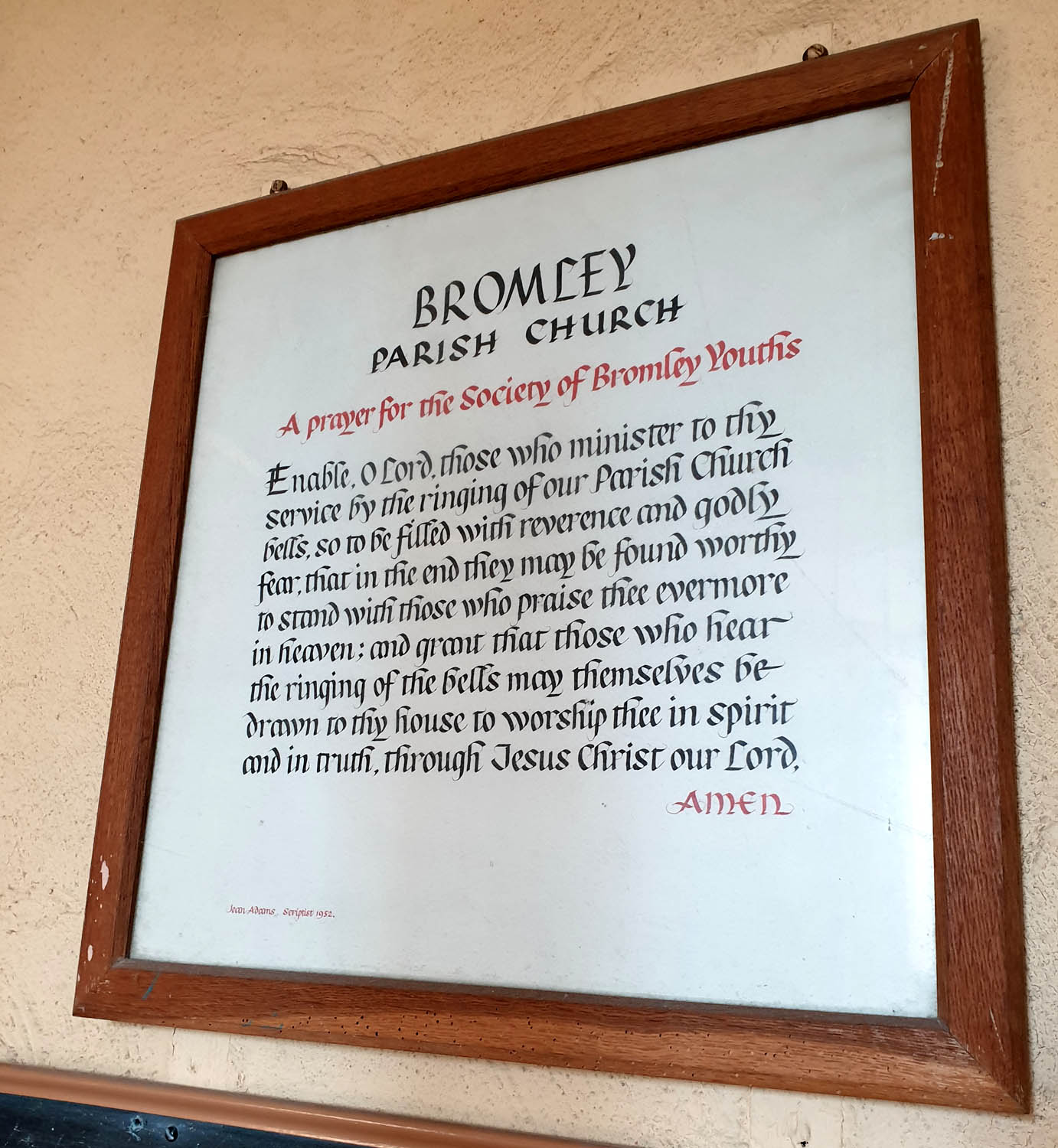
Photo: Dickon R Love, 12 April 2020
Framed card Bell/Restoration detail Board dated approx. 1950
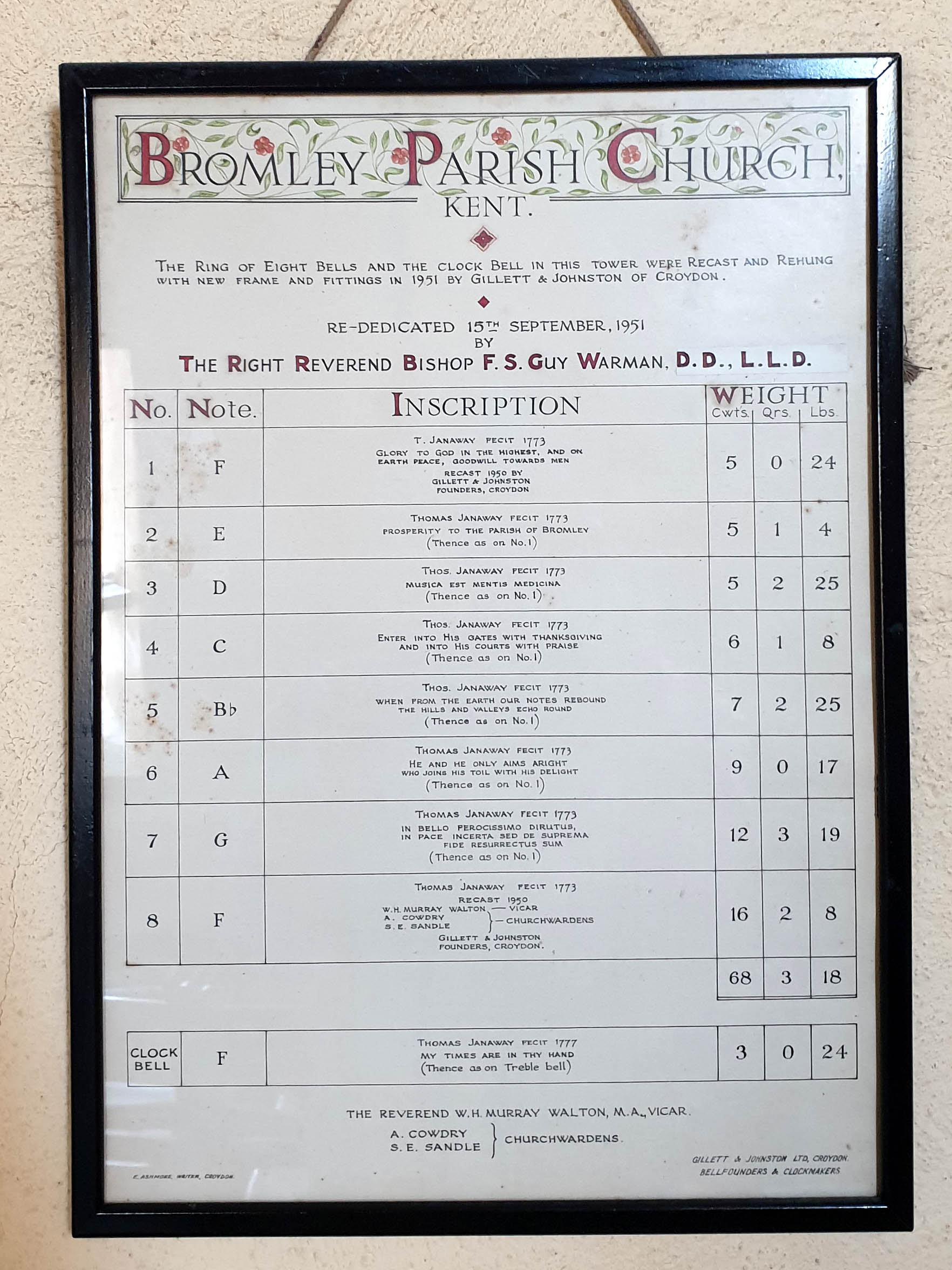
Photo: Dickon R Love, 12 April 2020
Framed card Performance Board dated approx. 1968
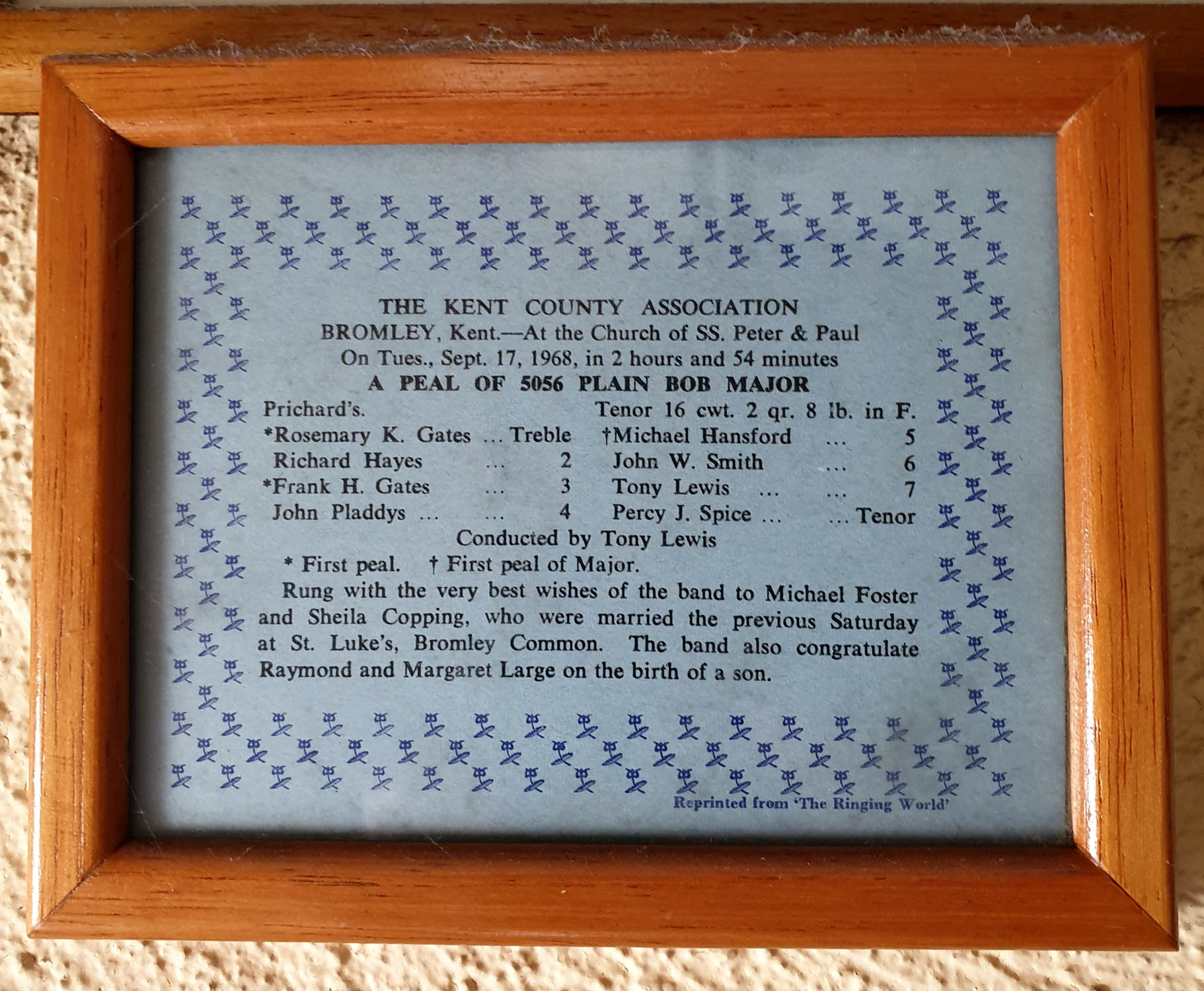
Photo: Dickon R Love, 12 April 2020
Framed card Performance Board dated approx. 1985
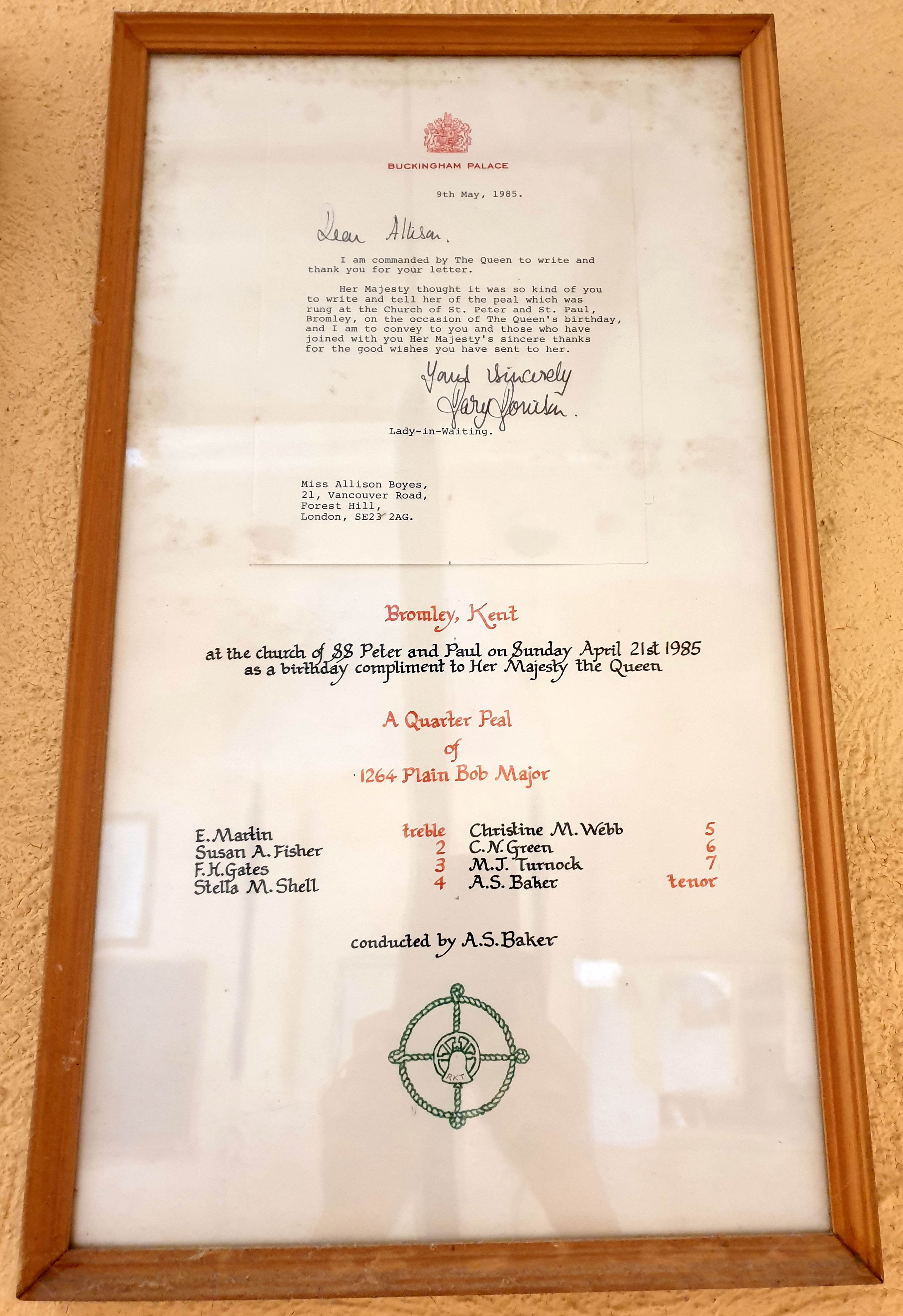
Photo: Dickon R Love, 12 April 2020
Framed card Performance Board dated approx. 1986
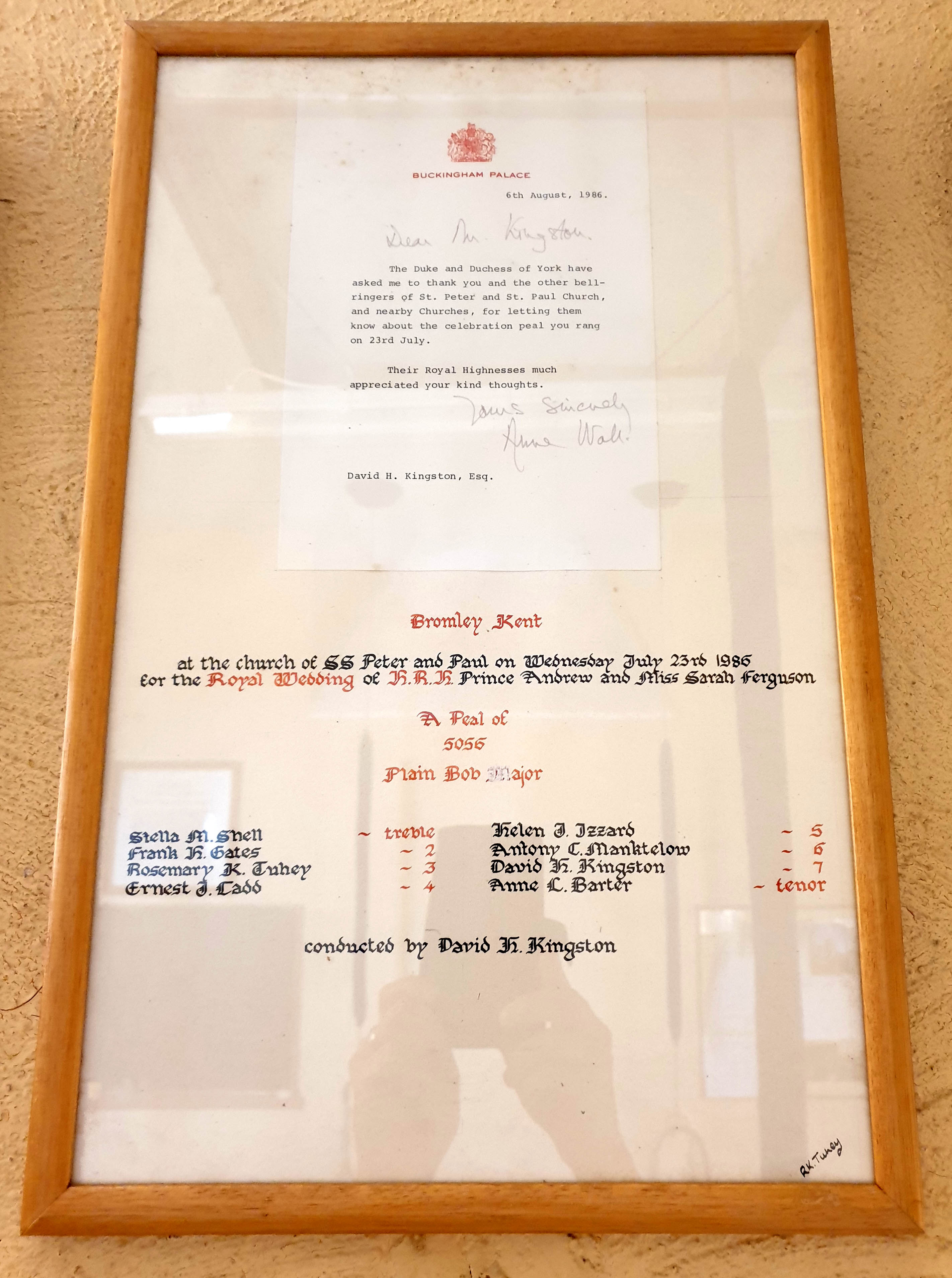
Photo: Dickon R Love, 12 April 2020
Framed card Performance Board dated approx. 1986
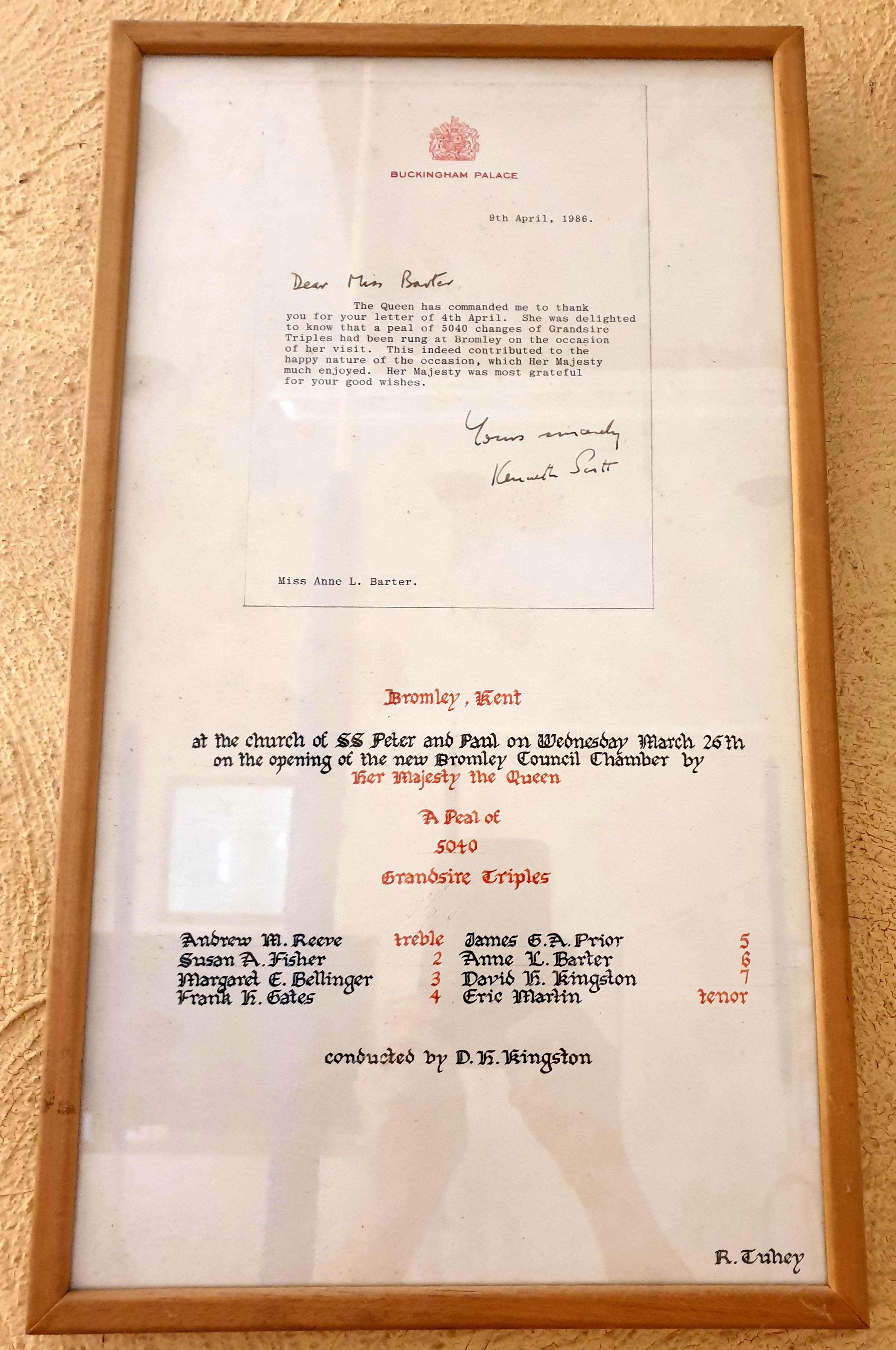
Photo: Dickon R Love, 12 April 2020
Framed card Performance Board dated 2014
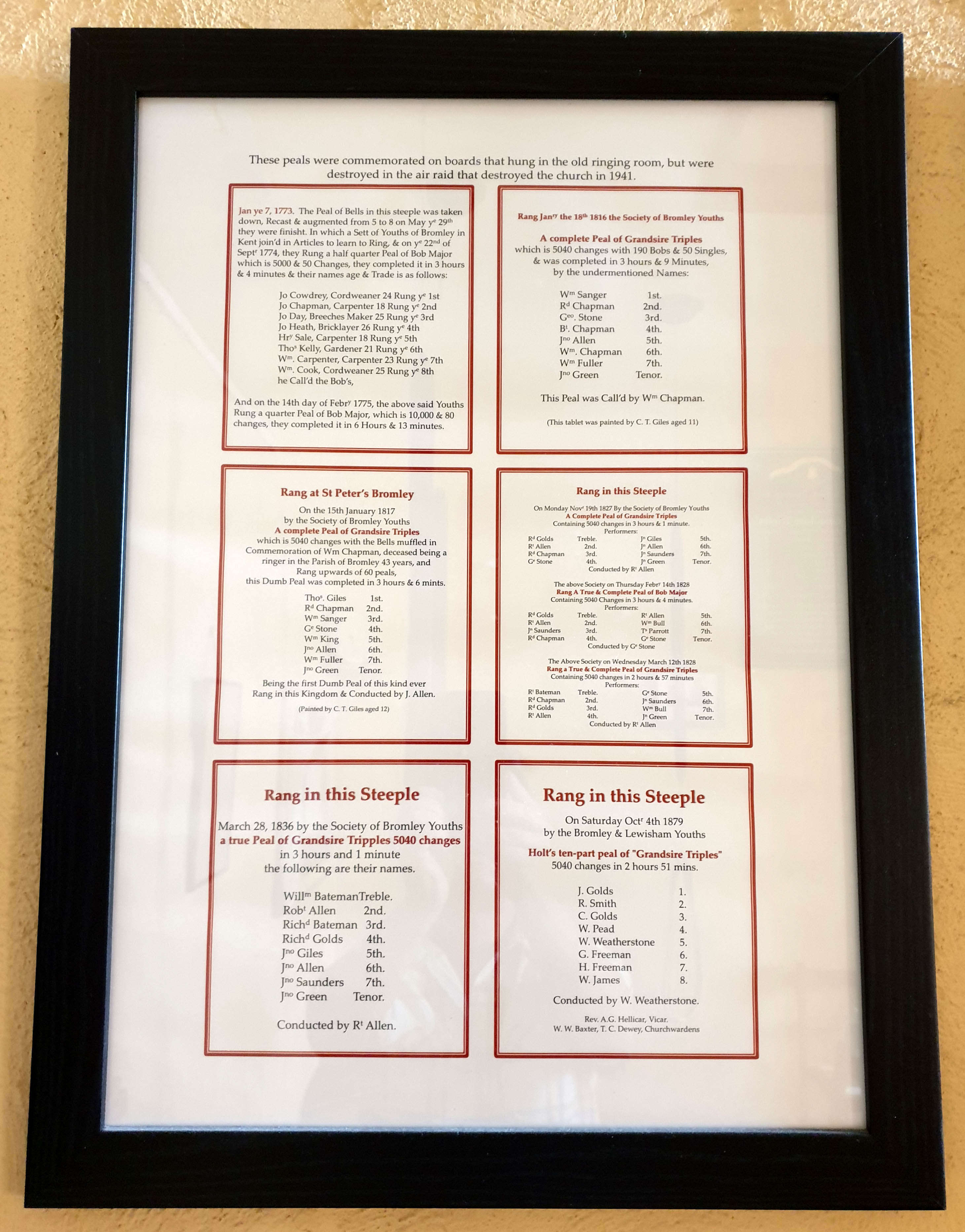
Photo: Dickon R Love, 12 April 2020
Framed card Performance Board dated 2014
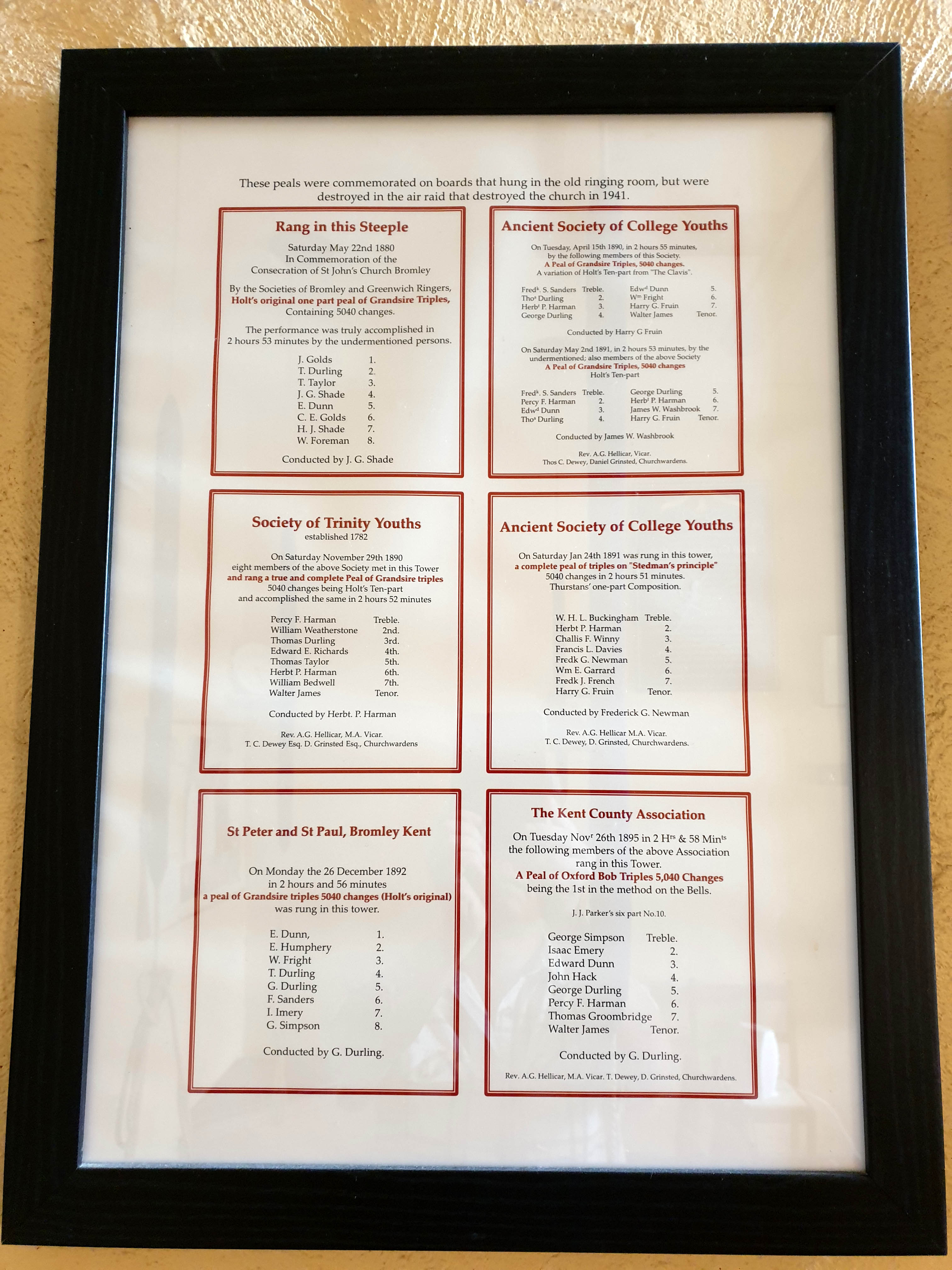
Photo: Dickon R Love, 12 April 2020
Framed card Performance Board dated 2014
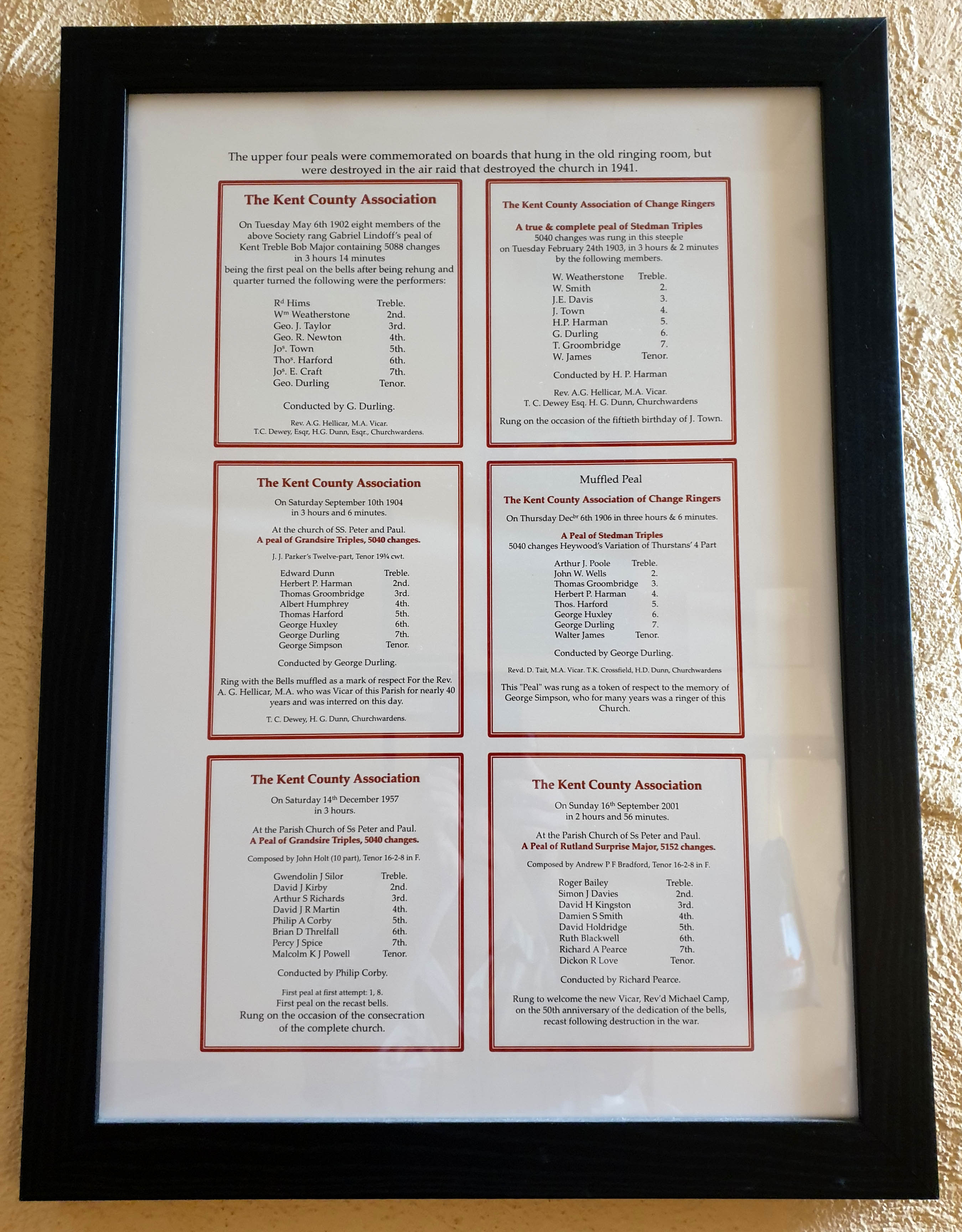
Photo: Dickon R Love, 12 April 2020
Timber Performance Board dated approx. 2017
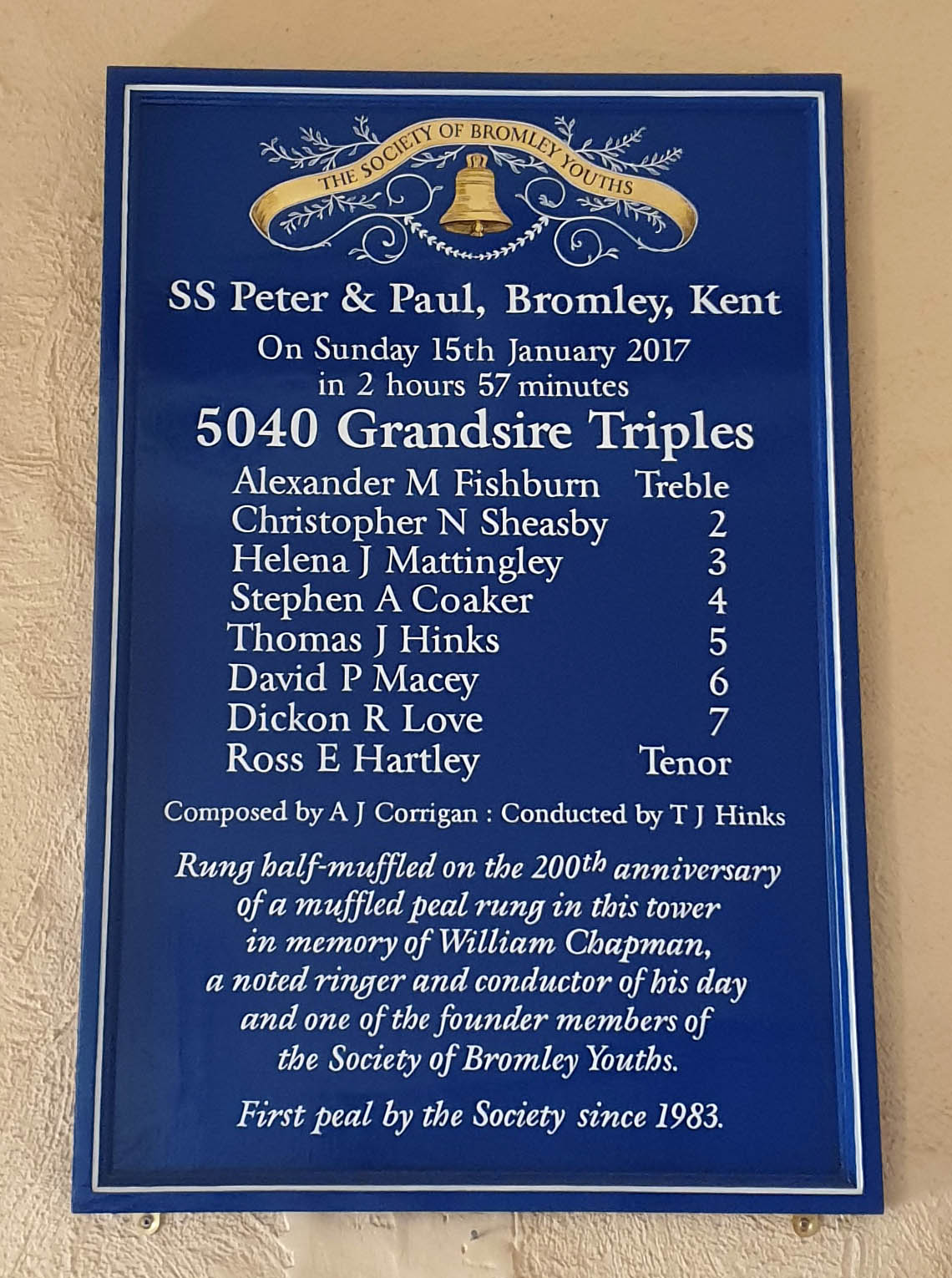
Photo: Dickon R Love, 12 April 2020
Page updated: 1 April 2016