


Photo: Brian Butcher
♫ Sound clip of the ring of 8 bells before they were augmented to 10 in 1992.(c. 1979)
| Bell | Weight (most recent) |
(As supplied 1914) |
Diameter | Note | Date | Founder | Canons | Retuned | ||
|---|---|---|---|---|---|---|---|---|---|---|
| ® | Treble | 4-3-19 | 27" | G | 1992 | Whitechapel Bell Foundry | Flat | Never | ||
| ® | 2 | 5-0-17 | 28" | F | 1992 | Whitechapel Bell Foundry | Flat | Never | ||
| ® | 3 | 5-1-23 | 29½" | E♭ | 1928 | Mears & Stainbank, Whitechapel | Flat | Never | ||
| ® | 4 | 6-1-2 | 30½" | D | 1928 | Mears & Stainbank, Whitechapel | Flat | Never | ||
| ® | 5 | 6-3-9 | 32¼" | C | 1928 | Mears & Stainbank, Whitechapel | Flat | Never | ||
| ® | 6 | 7-2-19 | 34½" | B♭ | 1928 | Mears & Stainbank, Whitechapel | Flat | Never | ||
| ® | 7 | 8-3-8 | 37½" | A♭ | 1928 | Mears & Stainbank, Whitechapel | Flat | Never | ||
| ® | 8 | 9-1-21 | 9-2-22 | 39¾" | G | 1914 | Mears & Stainbank, Whitechapel | Removed | 1928 Mears & Stainbank | |
| ® | 9 | 13-1-24 | 43½" | F | 1934 | Mears & Stainbank, Whitechapel | Flat | Never | ||
| ® | Tenor | 19-3-3 | 48½" | E♭ | 1992 | Whitechapel Bell Foundry | Flat | Never |
® - Hung for full circle ringing
| Position | Frame | Bells | Year | Maker | Material | Truss(es) | Local Layout |
|
|---|---|---|---|---|---|---|---|---|
| Lower tier | 1 | 3,4,5,6,7,8,9,10 | 1928 | Mears & Stainbank, Whitechapel | ||||
| Upper tier | 2 | 1,2 | 1992 | Local |

| Bell | Weight (most recent) |
(Cast weight) |
Diameter | Date | Founder | Retuned | Fate | |
|---|---|---|---|---|---|---|---|---|
| Treble (of 10) | 3-3-24 | 28" | 1861 | George Mears & Co. | Never | Scrapped 1891 | ||
| 2 (of 10) | 4-3-7 | 29" | 1861 | George Mears & Co. | Never | Scrapped 1891 | ||
| 3 (of 10) | 6-3-18 | 6-3-8 | 30" | 1802 | Thomas Mears I | Never | Pre-retuned weight is the cast weight.Recast in 1928 | |
| 4 (of 10) | 6-0-26 | 6-0-25 | 30½" | 1802 | Thomas Mears I | Never | Pre-retuned weight is the cast weight. Recast in 1928 | |
| 5 (of 10) | 6-2-16 | 6-2-15 | 32" | 1802 | Thomas Mears I | Never | Pre-retuned weight is the cast weight. Maiden bell. Recast in 1928 | |
| 6 (of 10) | 7-2-12 | 7-2-10 | 34½" | 1802 | Thomas Mears I | Never | Pre-retuned weight is the cast weight. Recast in 1928 | |
| 7 (of 10) | 9-0-0 | 9-0-8 | 37" | 1802 | Thomas Mears I | Never | Pre-retuned weight is the cast weight. Recast in 1928 | |
| 8 (of 10) | 11-1-21 | 12-0-27 | 41" | 1802 | Thomas Mears I | Never | Pre-retuned weight is the cast weight. Recast in 1914. Recorded in 1802 as 12-0-24 | |
| 9 (of 10) | 13-3-4 | 13-3-9 | 43" | 1802 | Thomas Mears I | Never | Weight is the cast weight. Was Maiden bell. Recast in 1891. | |
| Tenor (of 10) | 18-2-0 | 18-2-8 | 48½" | 1802 | Thomas Mears I | Never | Pre-retuned weight is the cast weight. Was Maiden bell. Recast in 1891. |

| Bell | Weight (most recent) |
(Measured 1928) |
(On 1891 plaque in the tower) |
Date | Founder | Retuned | Fate | |
|---|---|---|---|---|---|---|---|---|
| 7 (of 8) | 13-3-24 | 13-3-12 | 14-1-4 | 1891 | Mears & Stainbank | Never | Recast 1934. (Recorded in 1891 as 13-3-12) | |
| Tenor (of 8) | 19-0-9 | 19-3-23 | 1891 | Mears & Stainbank | Never | Recast 1992 |

| Bell | Date | Founder | Retuned | Fate | |
|---|---|---|---|---|---|
| Treble (of 6) | 1752 | Thomas Pack | Never | Smashed 1750. Recast 1752. | |
| 2nd (of 6) | 1720 | John Waylett | Never | Recast 1802 | |
| 3rd (of 6) | 1720 | John Waylett | Never | Recast 1802 | |
| 4th (of 6) | 1720 | John Waylett | Never | Recast 1802 | |
| 5th (of 6) | 1720 | John Waylett | Never | Recast 1802 | |
| Tenor (of 6) | 1720 | John Waylett | Never | Recast 1802 |
| Bell | Date | Founder | Retuned | Fate | |
|---|---|---|---|---|---|
| Treble (of 6) | 1720 | John Waylett | Never | Smashed 1750. Recast 1752 |
| 1413 | Churchwardens accounts mentions "materials for greasing the bells 5½d. | ||
| 1481 | An entry from the Historical Manuscripts Commission gives details of a major overhaul including replacing the frame and repairs to the 4th and the Great Bell. There were therefore at least 5 bells in the tower. | ||
| 1580 | 6th Mar | The tower was shaken by an earthquake "so violent that the bells sounded." | |
| 1697 | Thomas Raylton was paid £12 10s "for 12 brasses" indicating that there were at least 6 bells in the tower at the time. | ||
| 1703 | John Walker was paid "£12-15s-00d for 2 bells". These were possibly for 2 new bells making up the ring to 8, but more likely to have been for a recast of 2 of the existing bells, or for service/sanctus bells. | ||
| New ❻ | 1720 | 6 bells were recast by John Waylett. If there were 8 bells in the tower, it could be that the back 6 were recast to match the old bells to the new. | |
| ❻→꙰ | 1739 | 24th Apr | The tower fell down. It was reported that 6 bells and some broken bells were dug from the ruins. This lends evidence to the fact that there were more than 6 bells in the tower, although some may have been service/sanctus bells. [1] |
| New ❻ | 1750 | The tower was rebuilt and 6 bells hung in it. | |
| 1752 | Tower rebuilt and treble (of 6) recast by Robert Pack. | ||
| 1757 | Record of 6 bells in the tower. [2] | ||
| 1799 | Record of 6 bells in the tower. [3] | ||
| New ❽ | 1802 | Bells recast into a (confirmed) ring of 8 by Thomas Mears I. | |
| ❽→❿ | 1861 | 2 trebles added by Thomas Mears II to make 10. They were bought by John Friend from George Mears using George Stockham as an agent. The money was never settled and there was a court case Stockham v. Friend (1862) to recover the value of these two bells. The judge ruled that the dispute should be harmonised between the parties. Friend also wanted to recast the tenor which was described as "recusant", although this did not happen. The new ring of 10 opened on 6th July. They were never very successful. The tuning of the octave was probably very stretched (as is the case at the similar but extant octave at Borden) so that when the trebles were added, they blatantly did not fit. The trebles were never pealed and soon fell into disuse. | |
| ❿→❽ | 1891 | Back 2 bells recast by Mears & Stainbank (including the "recusant tenor"). The 2 trebles were scrapped and the remaining 8 bells rehung. | |
| 1893 | Severe cracks were discovered in the tower so the bells were not rung. | ||
| 1901 | New clock provided, paid by public subscription in memory of Queen Victoria. | ||
| 1914 | 6th recast by Mears & Stainbank. This was "The Curfew Bell". | ||
| 1925 | A report to the PCC recorded that "the bells and organ are in urgent need of repair." | ||
| 1928 | Front 5 (of 8) recast by Mears & Stainbank and hung in a new frame. This was paid for by Lord Wakefield. | ||
| 1929 | Clock hammer was repaired. | ||
| 1934 | The 7th cracked during the ringing for a wedding. It was recast by Mears & Stainbank. | ||
| 1979 | KCACR did some work on a loose gudgeon on the 4th. | ||
| 1991 | The tenor was found to be cracked in the crown. | ||
| ❽→❿ | 1992 | Tenor recast, and 2 trebles added to make 10 by Whitechapel. They were cast in October. The first service ringing was Christmas Day. The fittings for these bells came from the old trebles of ten at Llandaff. York got the fittings of the back 8. |
| [1] | From "Hythe" published for the Corporation and Chamber of Commerce by The Health Resorts Association, 1923: "The original tower fell down in 1739. A party of visitors wished to ascend it for a view. Fortunately for them, the sexton took some time to get the key, and while they were waiting, and no doubt grumbling at the delay, the tower suddenly fell with a crash; no life was lost. The present tower was erected in 1750, and though but a poor imitation of Gothic in its details, it looks well at a distance. It contains a ring of eight bells, the largest weighing just a ton … The curfew bell is still rung every night at eight o'clock."' ('Corporation and Chamber of Commerce, 1923) |
| [2] | "The Tower fell down a few Years ago; but it is now rebuilt. It stands at the West End. In it hang 6 very Musical Bells. The First, or smallest of them, having been broke by ye Fall of The Tower, was recast by Robert Pack of London in 1752. The Year the new Tower was finish’t. The Other 5 were all founded by John Waylett in ye Year 1720. The Old Steeple (Kilburn informs us) was greatly damaged in ye Year 1580, by an Earthquake, which was so violent as to ring ye Bells in it. It is said, there were formerly 4 other Parish Churches, or Chapels, in Hythe; which were dedicated to St. Bernard, St. Nicholas, St Michael, and St. Mary."' ('Rev’d Bryan Faussett, 1757) |
| [3] | The church, which is dedicated to St. Leonard, is a fine handsome building, consisting of three isles, a north and south cross, and three chancels, with a tower steeple at the west end, in which are six bells and a clock.' (''The History and Topographical Survey of the County of Kent. Vol 8', Edward Hasted) |

The former 1891 tenor being taken out of the tower, destined to be recast at the Whitechapel Bell Foundry.
Photo: Christopher J Cooper, 1992

Photo: Christopher J Cooper, 1992
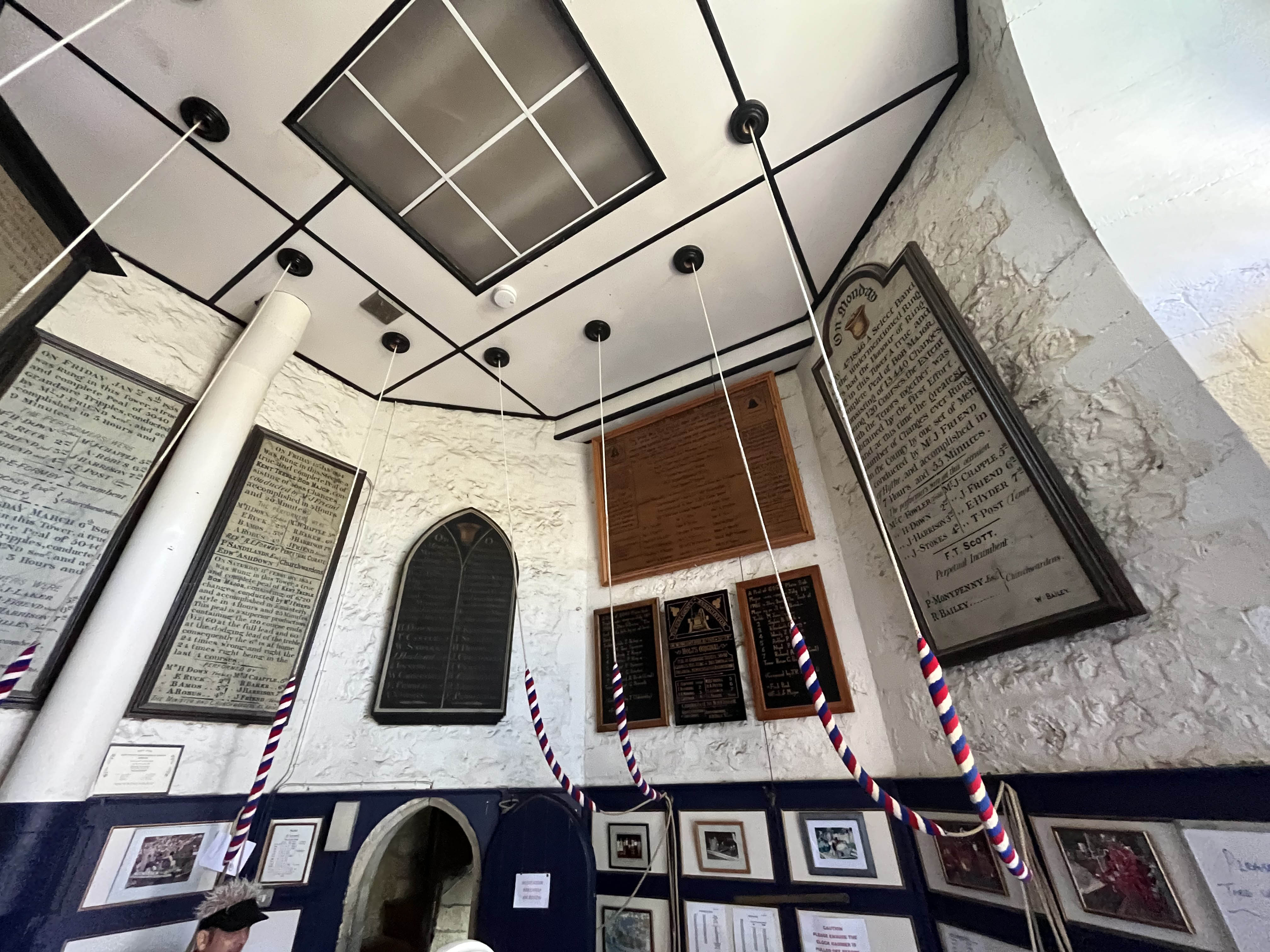
Photo: Richard Steele, July 2025
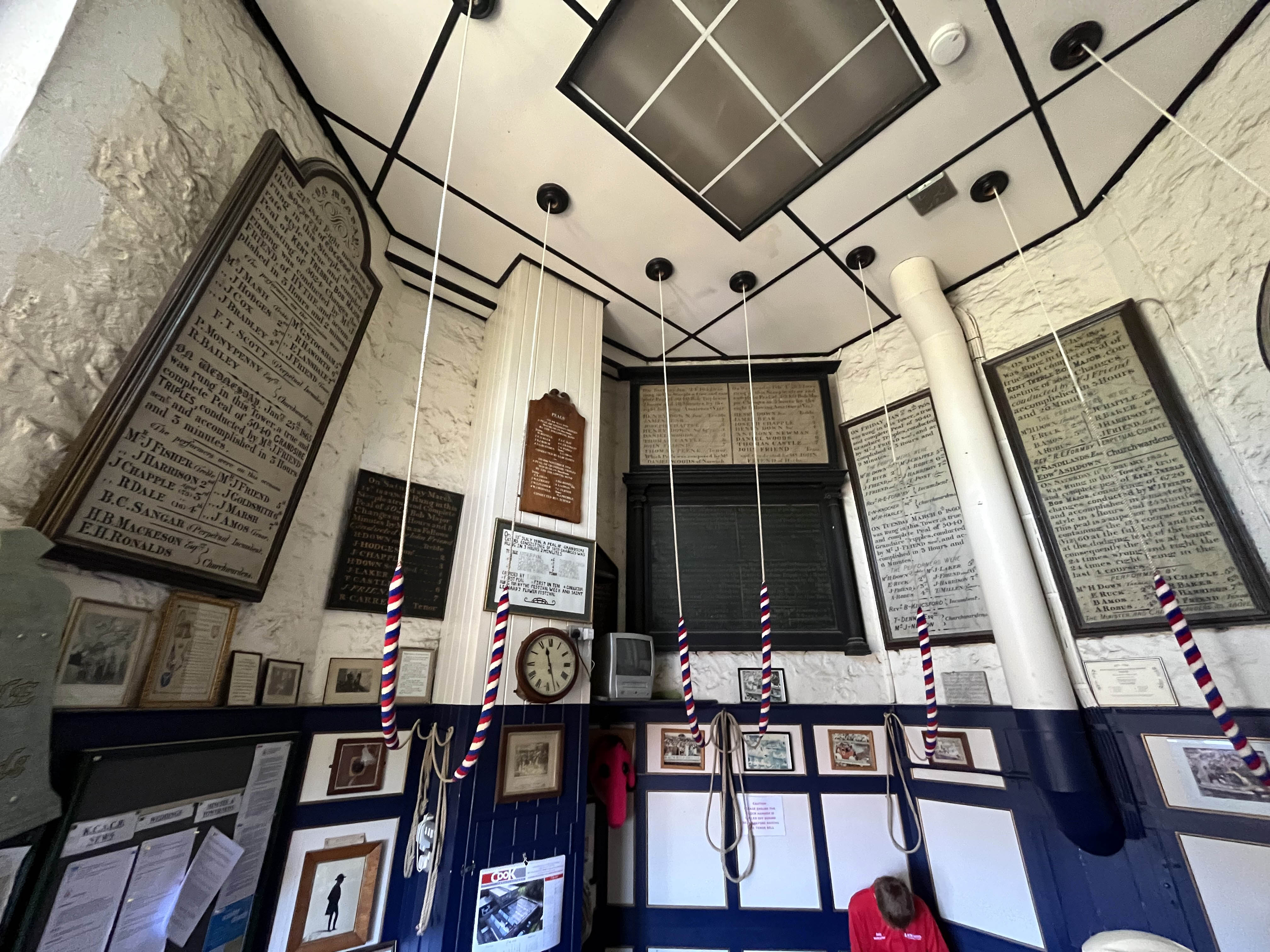
Photo: Richard Steele, July 2025
Timber Performance Board dated approx. 1818
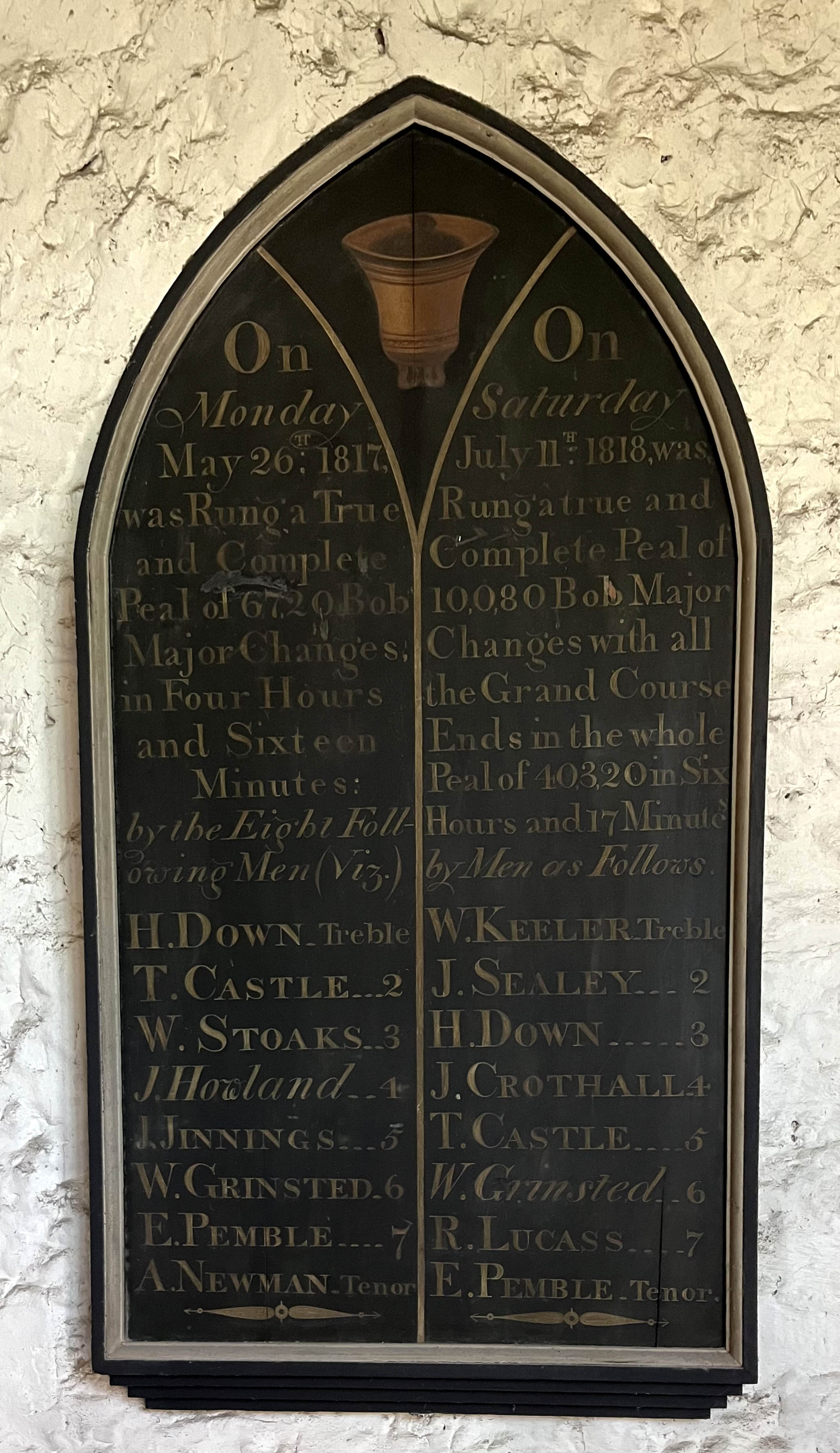
Photo: Richard Steele, 1 July 2025
Stone Performance Board dated approx. 1819
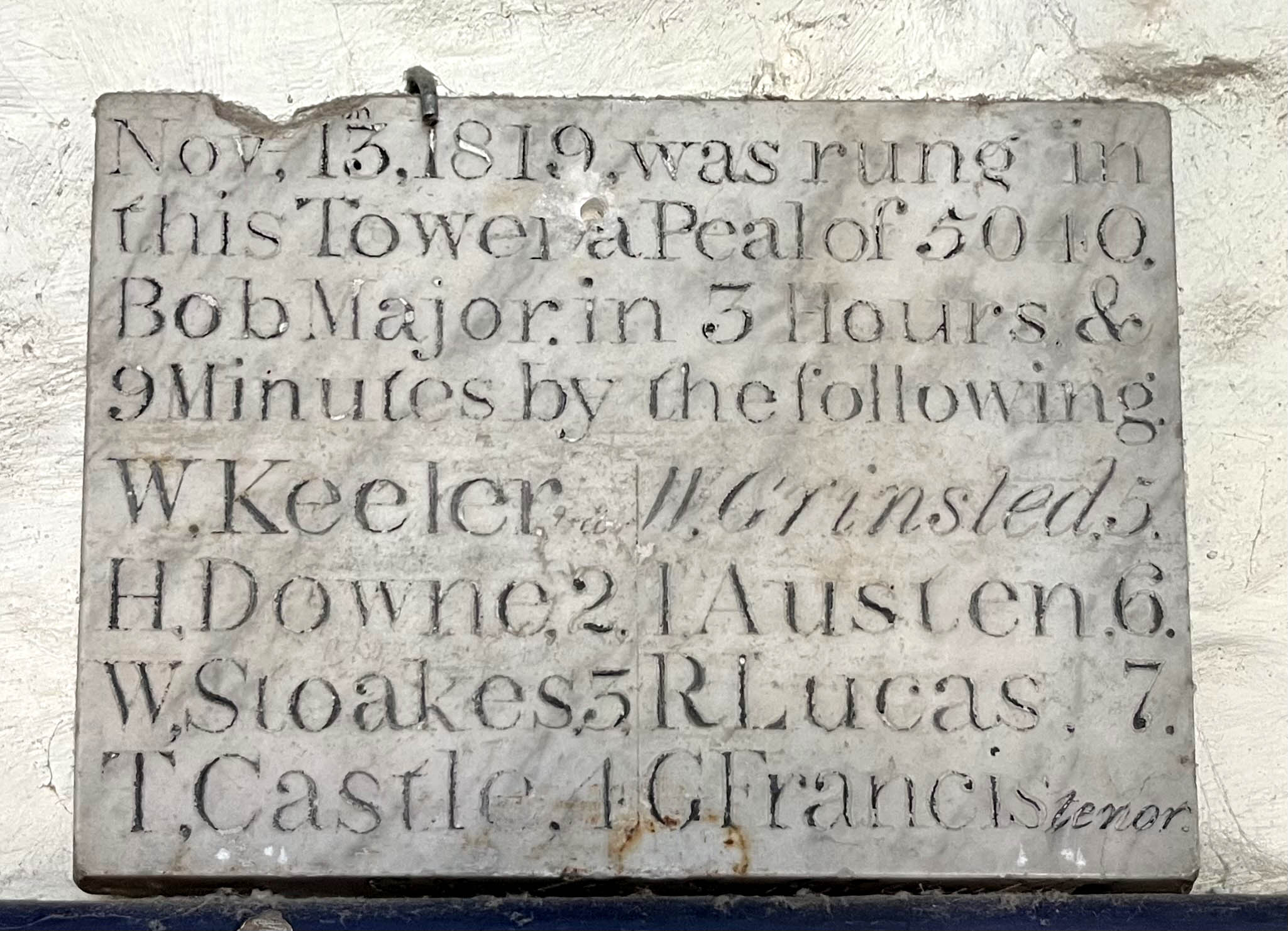
Photo: Richard Steele, 1 July 2025
Timber Performance Board dated approx. 1829
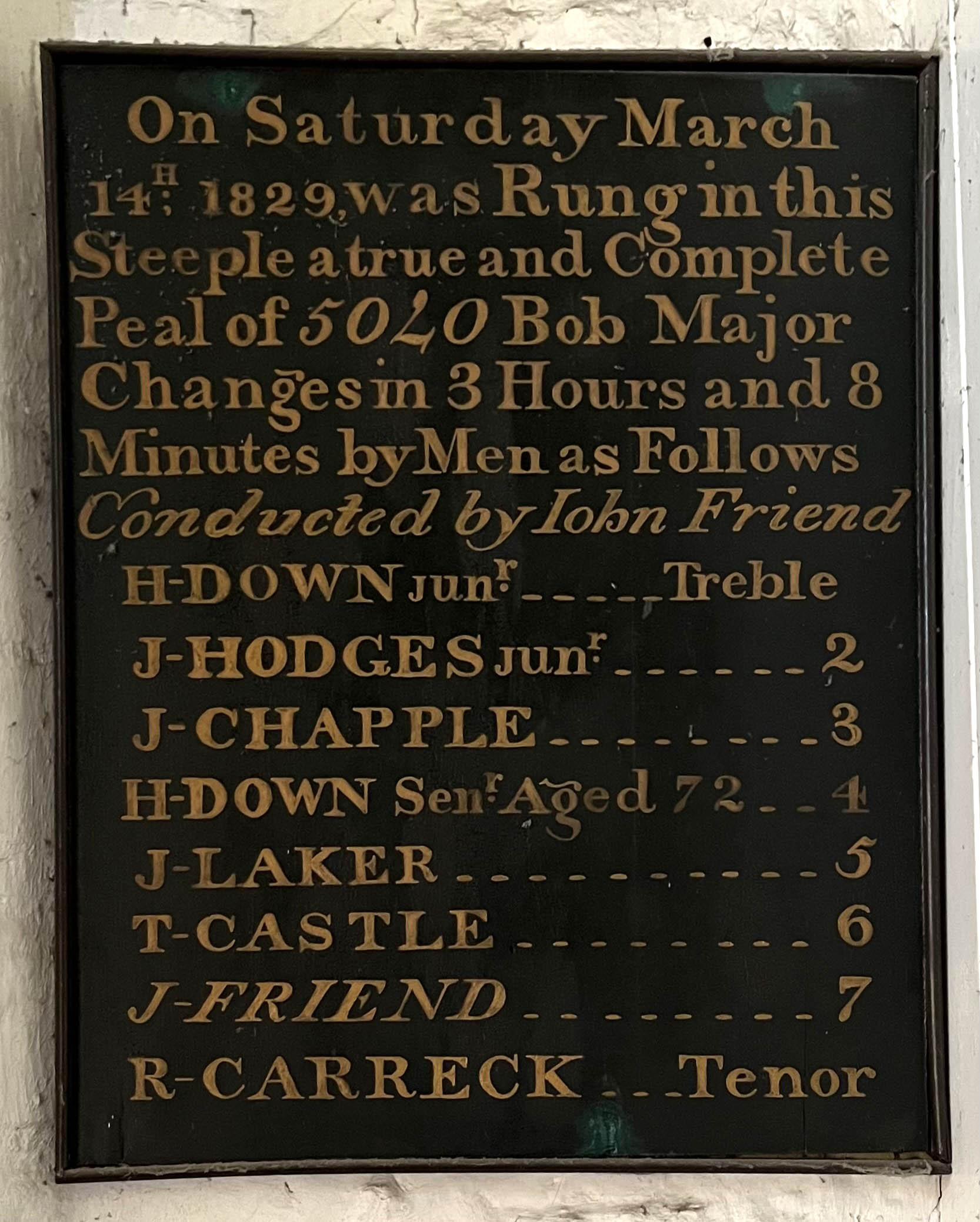
Photo: Richard Steele, 1 July 2025
Timber Performance Board dated approx. 1832
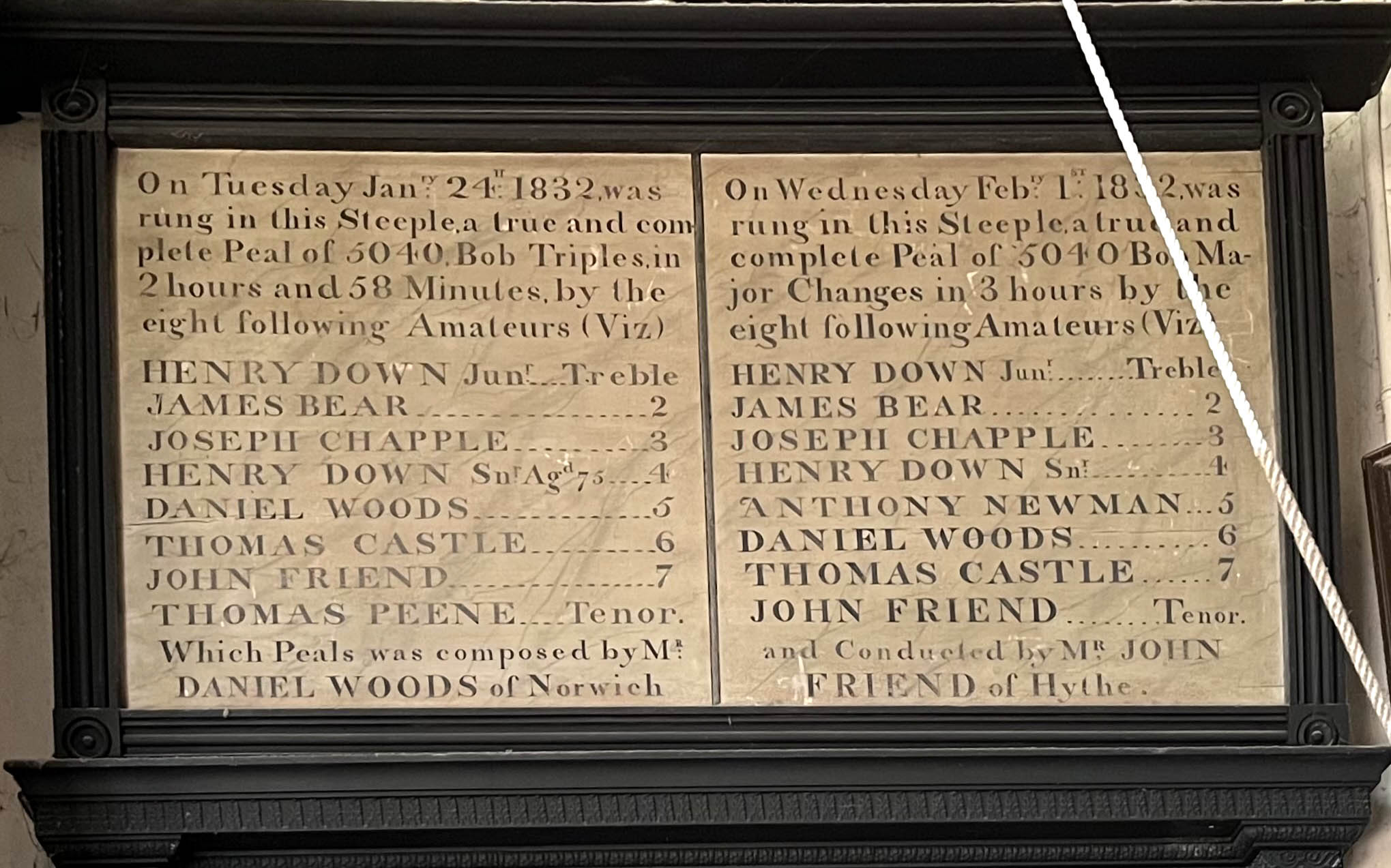
Photo: Richard Steele, 1 July 2025
Timber Performance Board dated approx. 1846
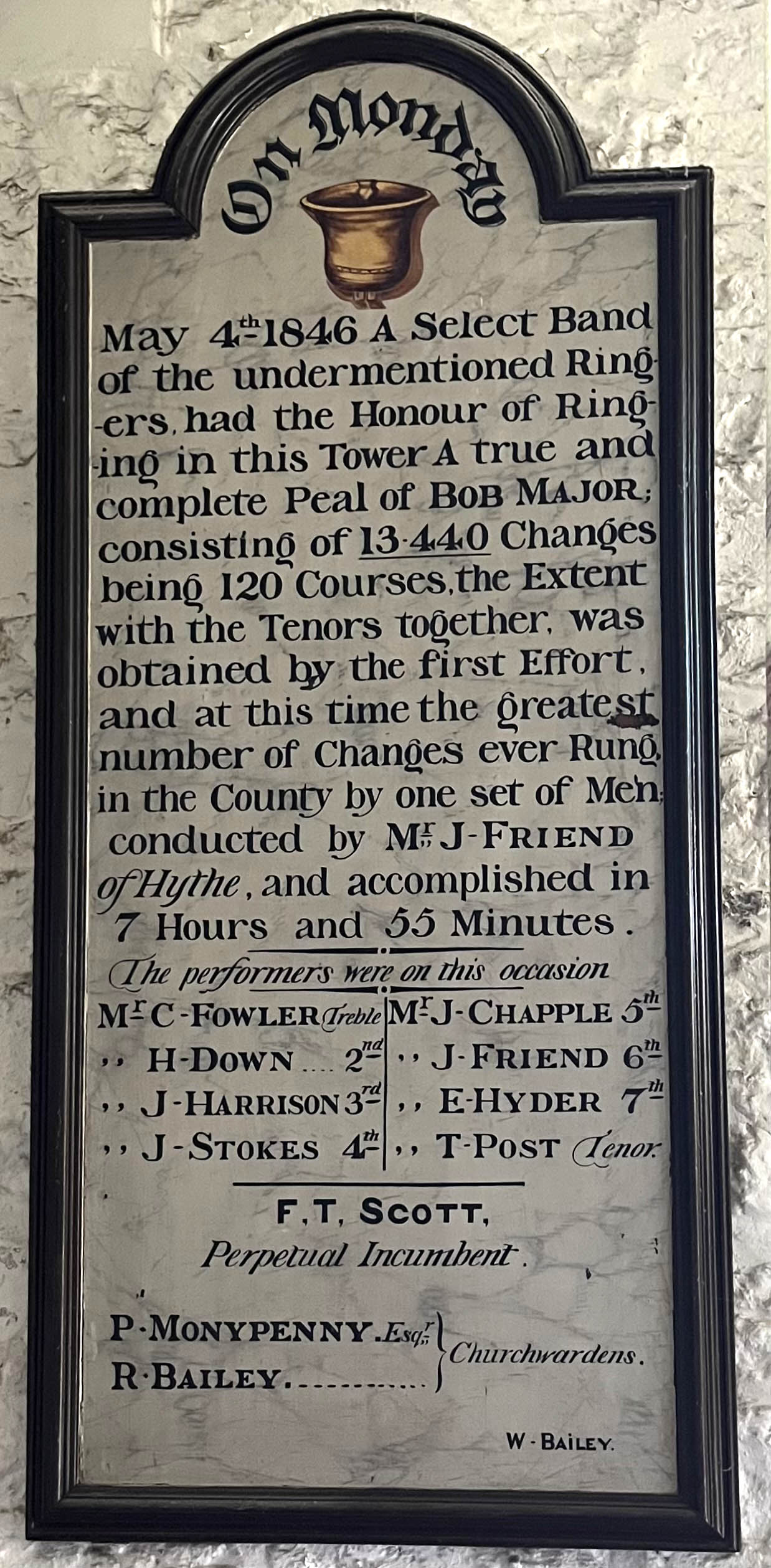
Photo: Richard Steele, 1 July 2025
Timber Performance Board dated approx. 1851
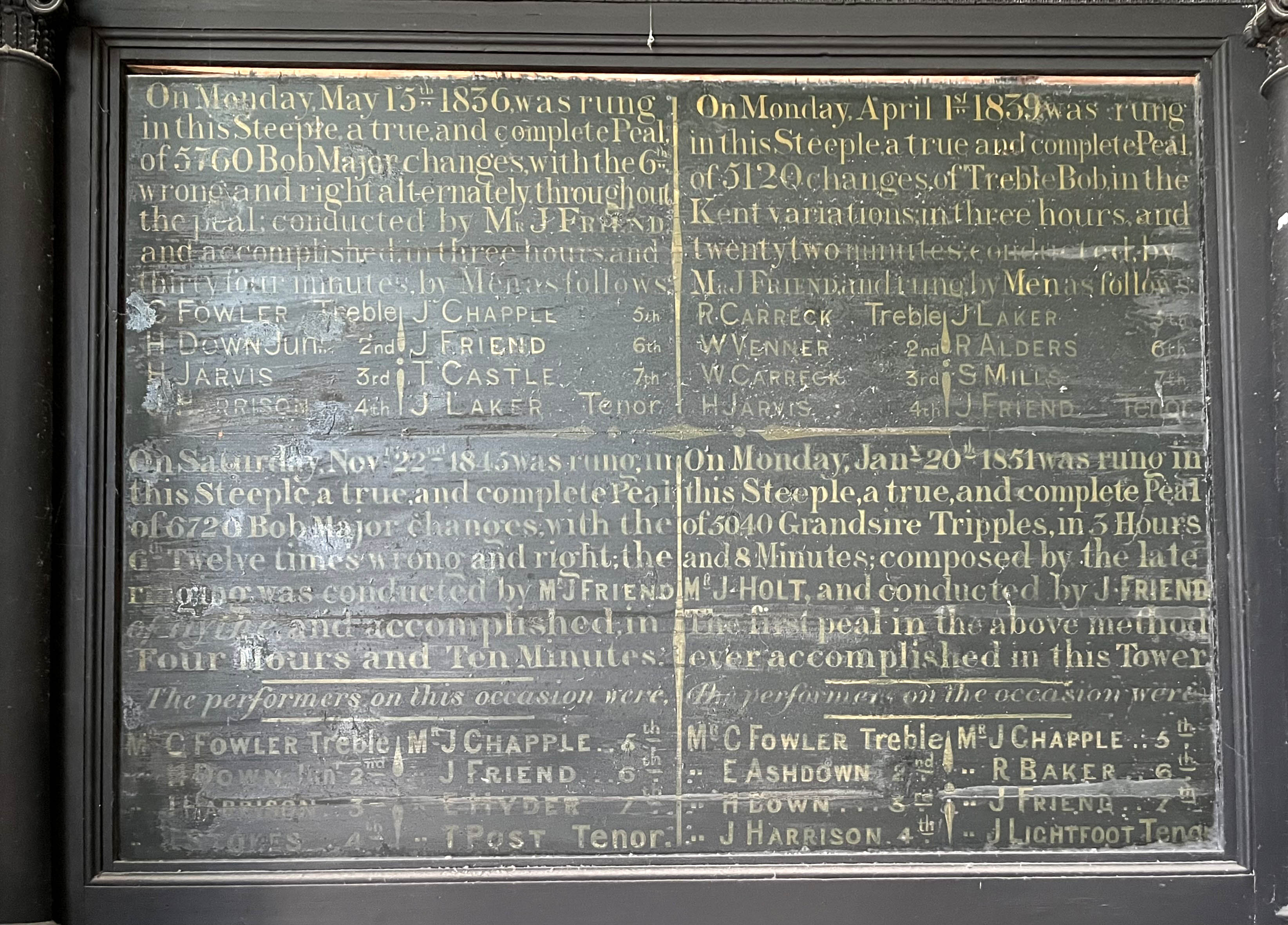
Photo: Richard Steele, 1 July 2025
Timber Performance Board dated approx. 1860
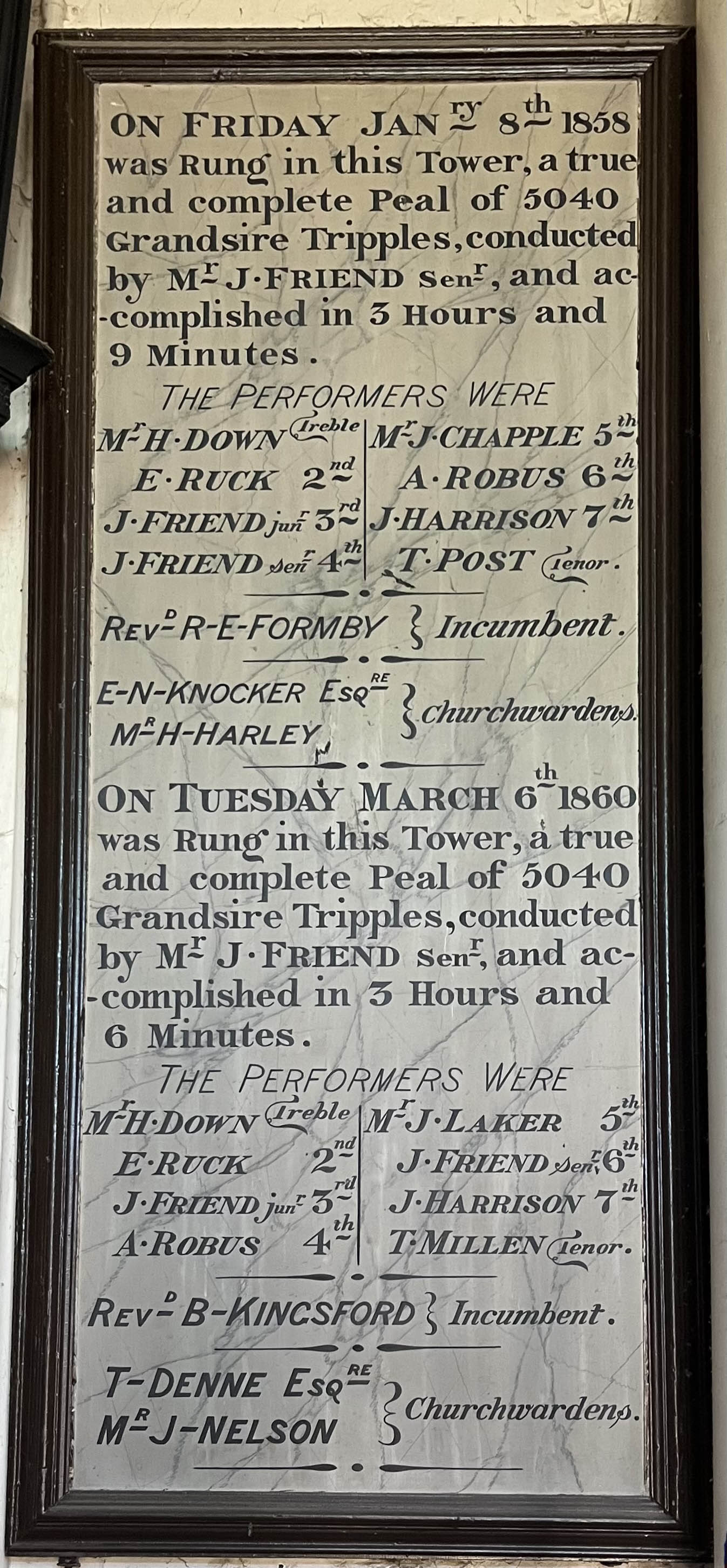
Photo: Richard Steele, 1 July 2025
Timber Performance Board dated approx. 1865
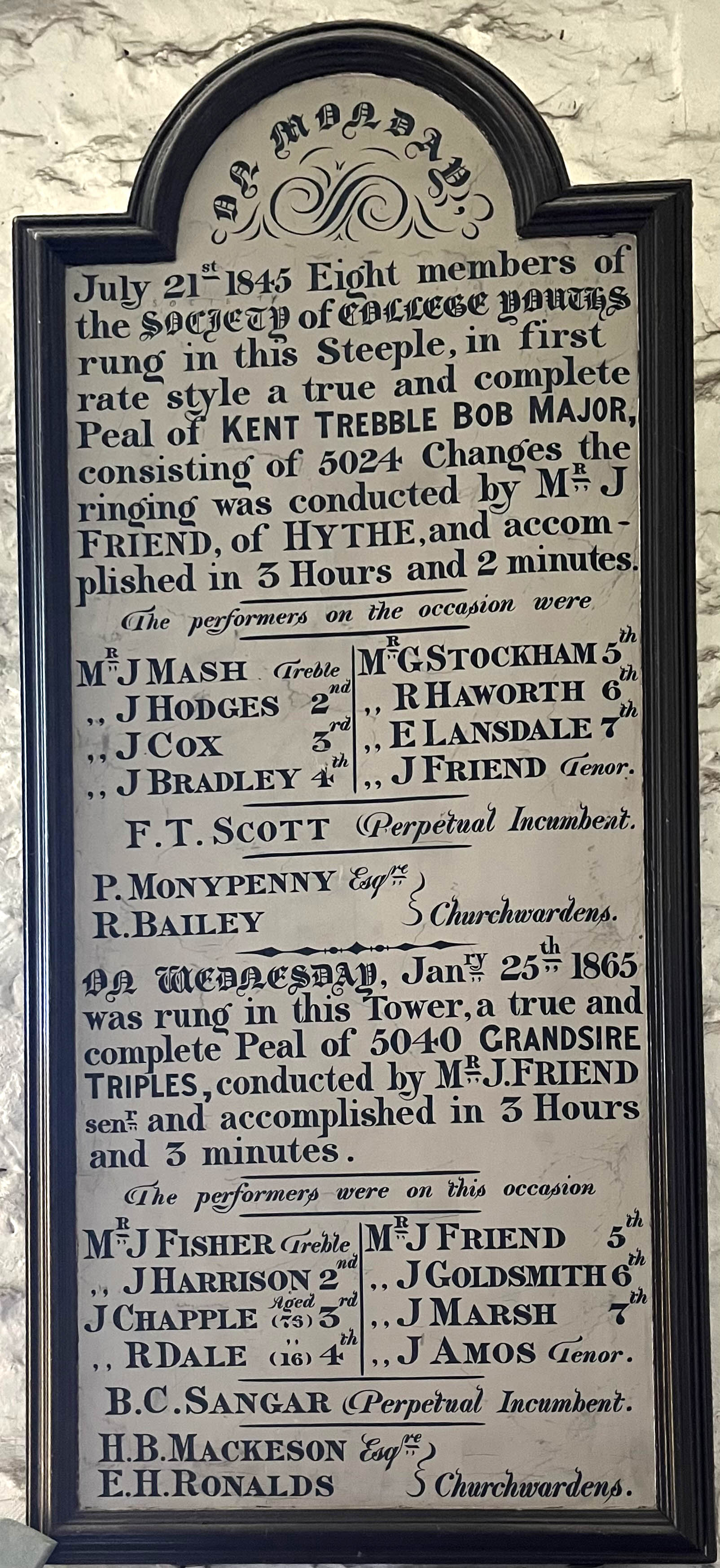
Photo: Richard Steele, 1 July 2025
Ceramic Performance Board dated approx. 1903
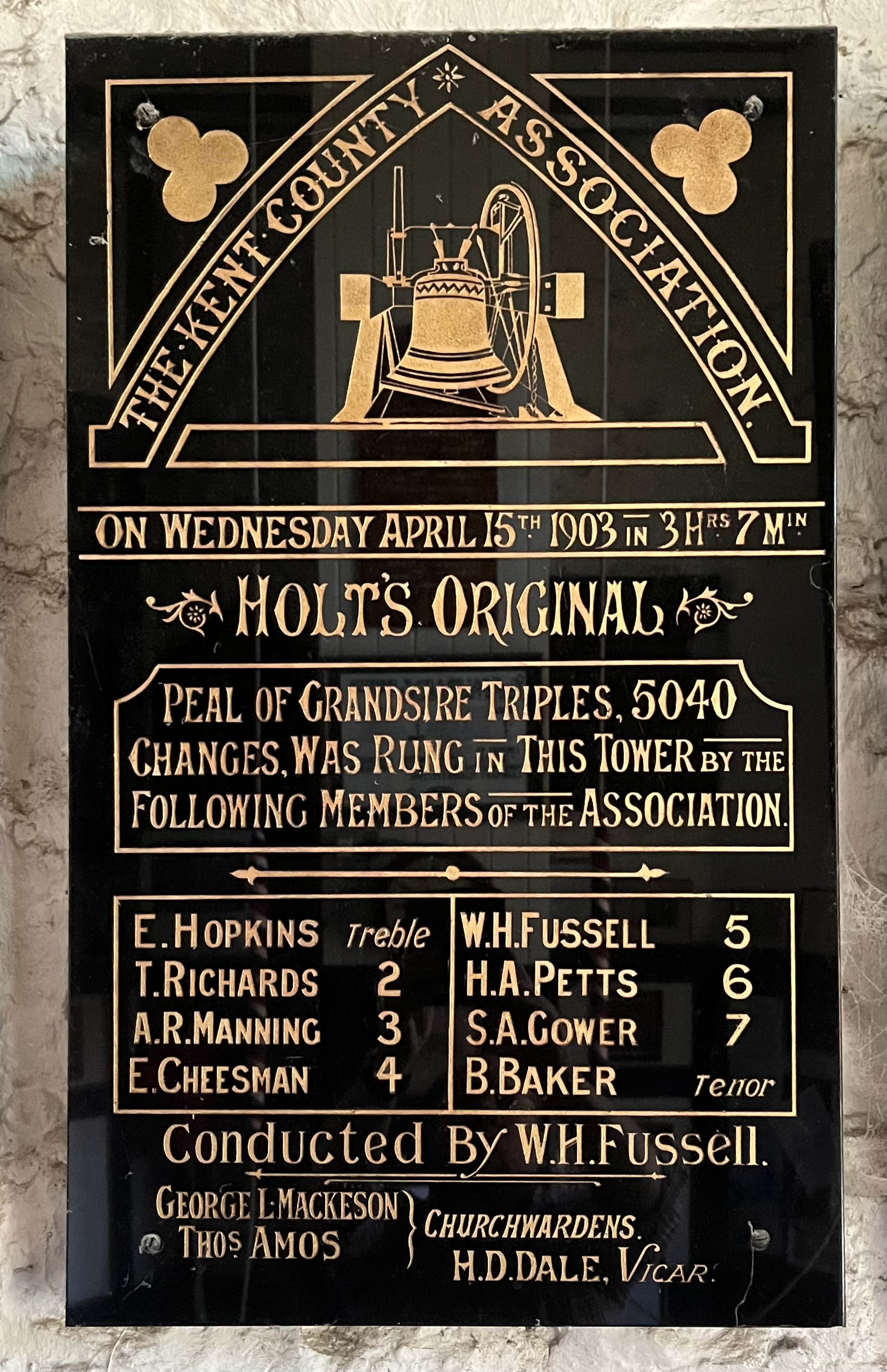
Photo: Richard Steele, 1 July 2025
Timber Performance Board dated approx. 1937
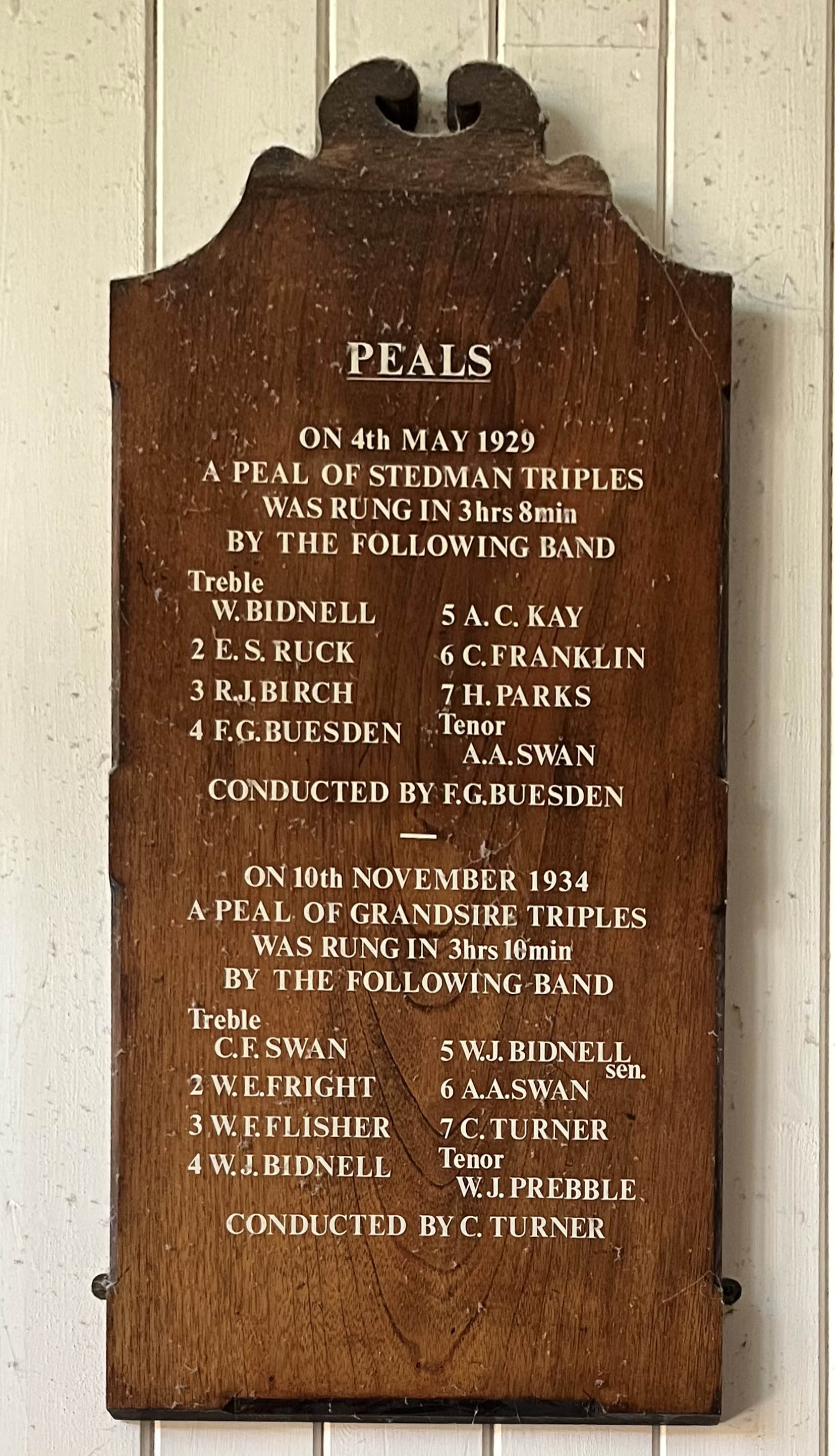
Photo: Richard Steele, 1 July 2025
Timber Performance Board dated approx. 1984
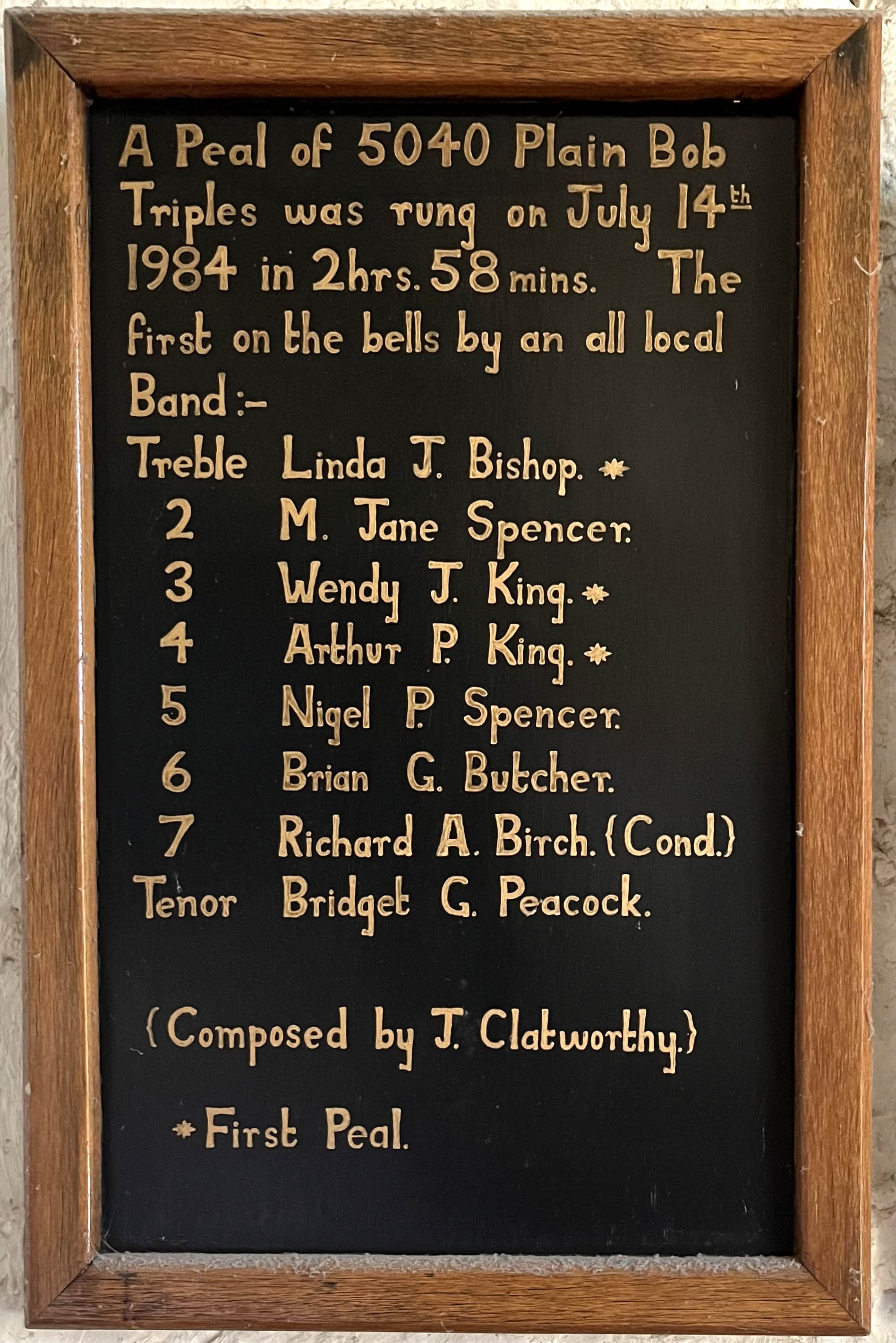
Photo: Richard Steele, 1 July 2025
Timber Performance Board dated approx. 1985
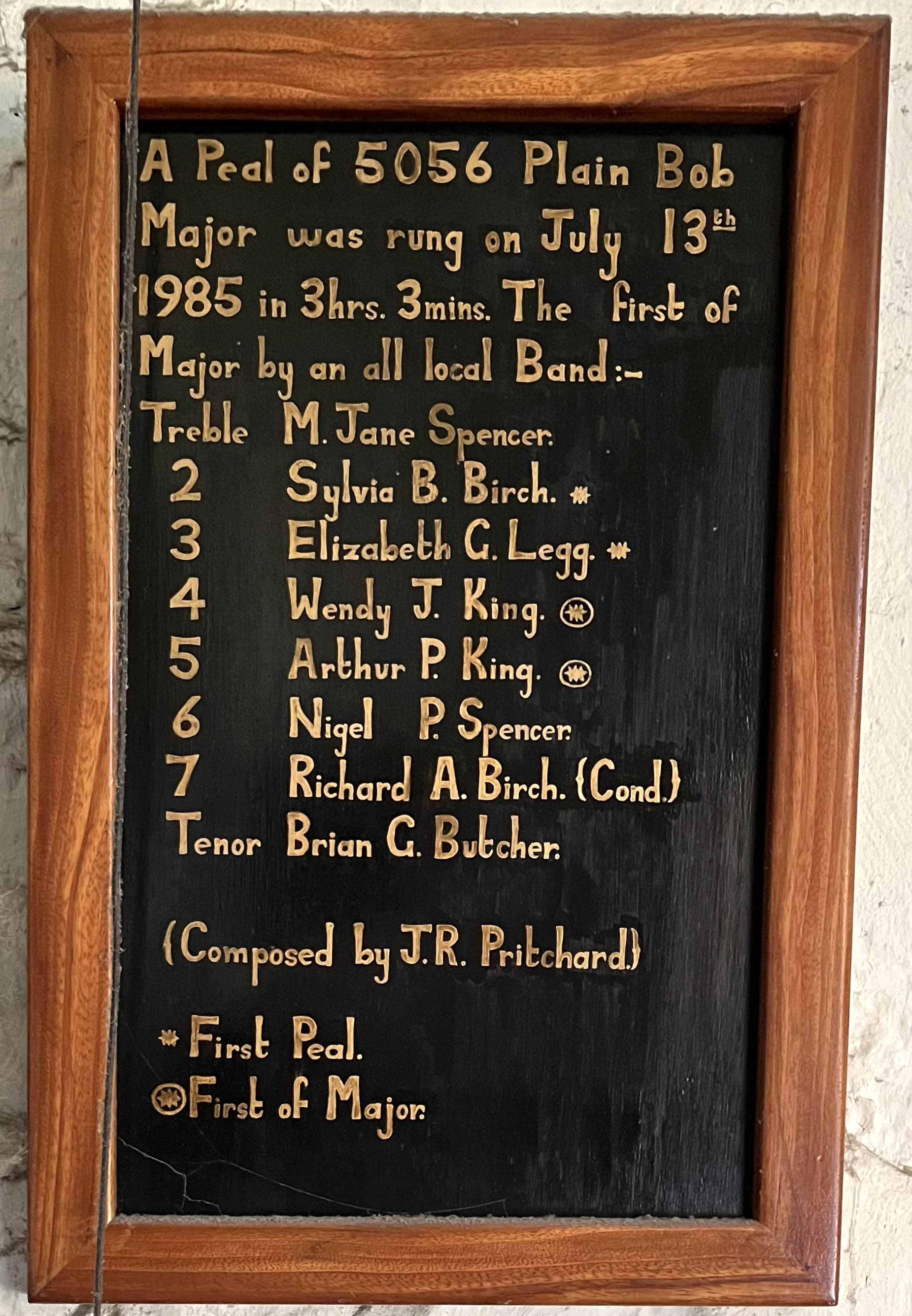
Photo: Richard Steele, 1 July 2025
Framed card Bell/Restoration detail Board dated 1992
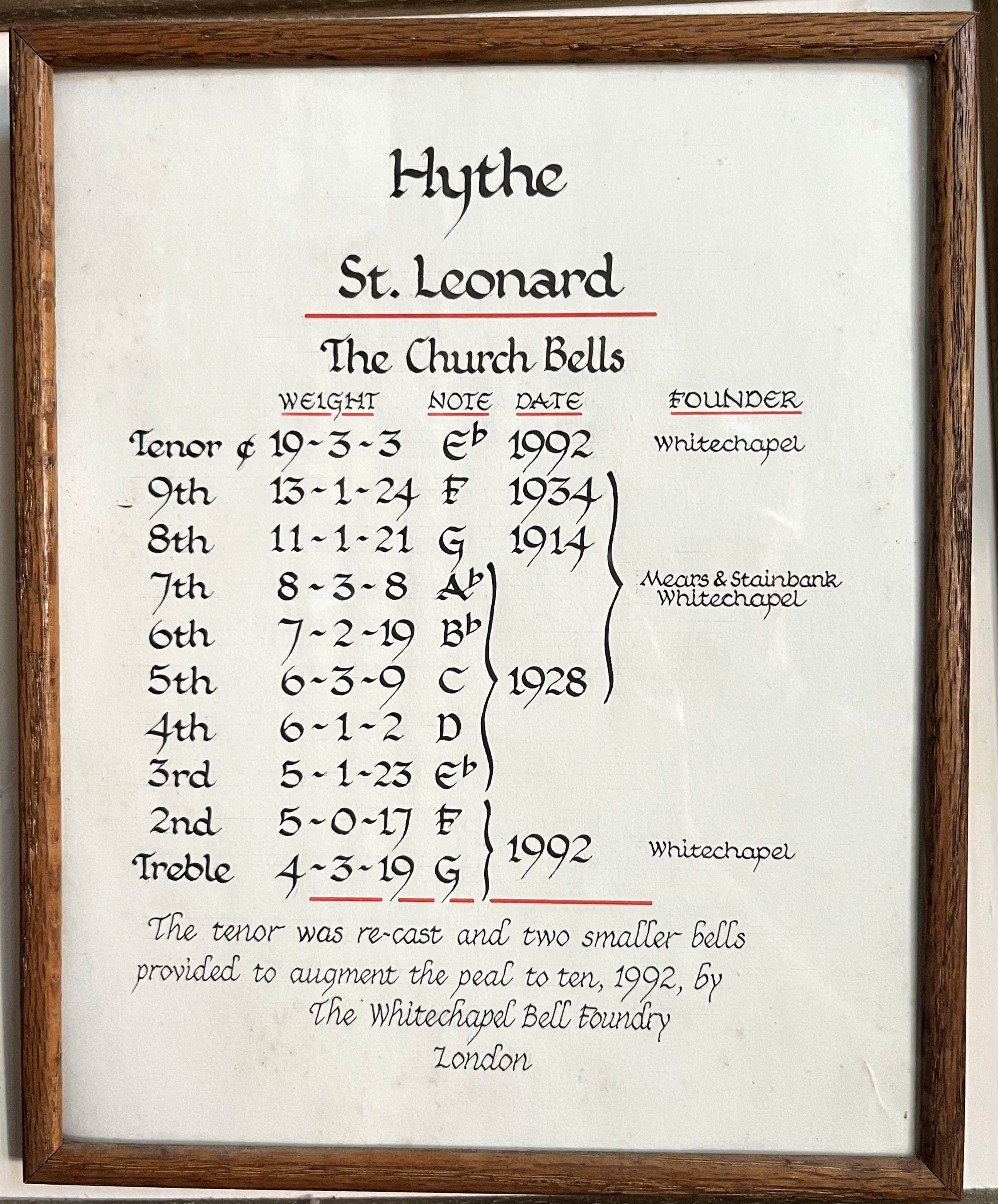
Photo: Richard Steele, 1 July 2025
Timber Performance Board dated approx. 1993
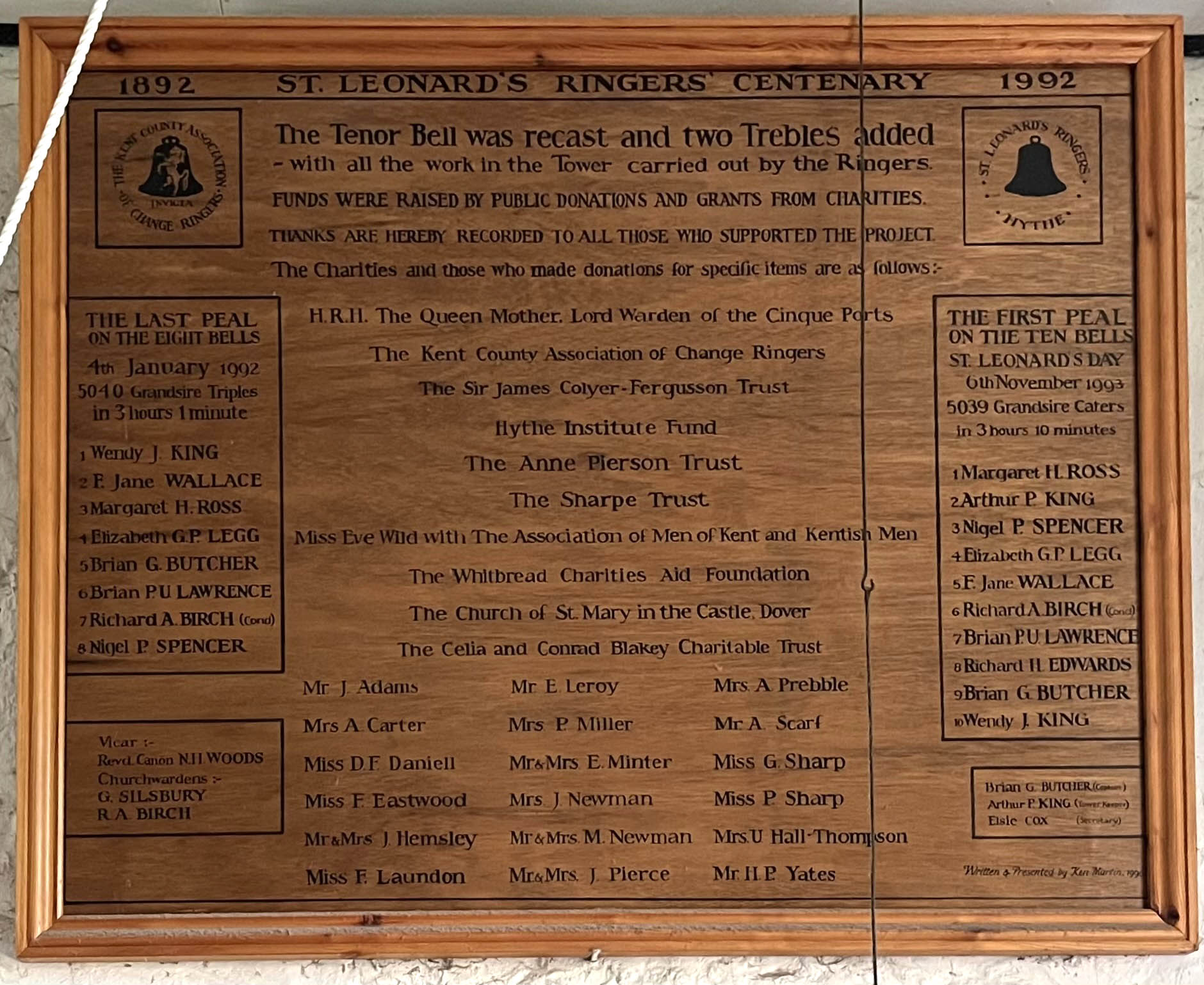
Photo: Richard Steele, 1 July 2025
Framed card Performance Board dated approx. 1996
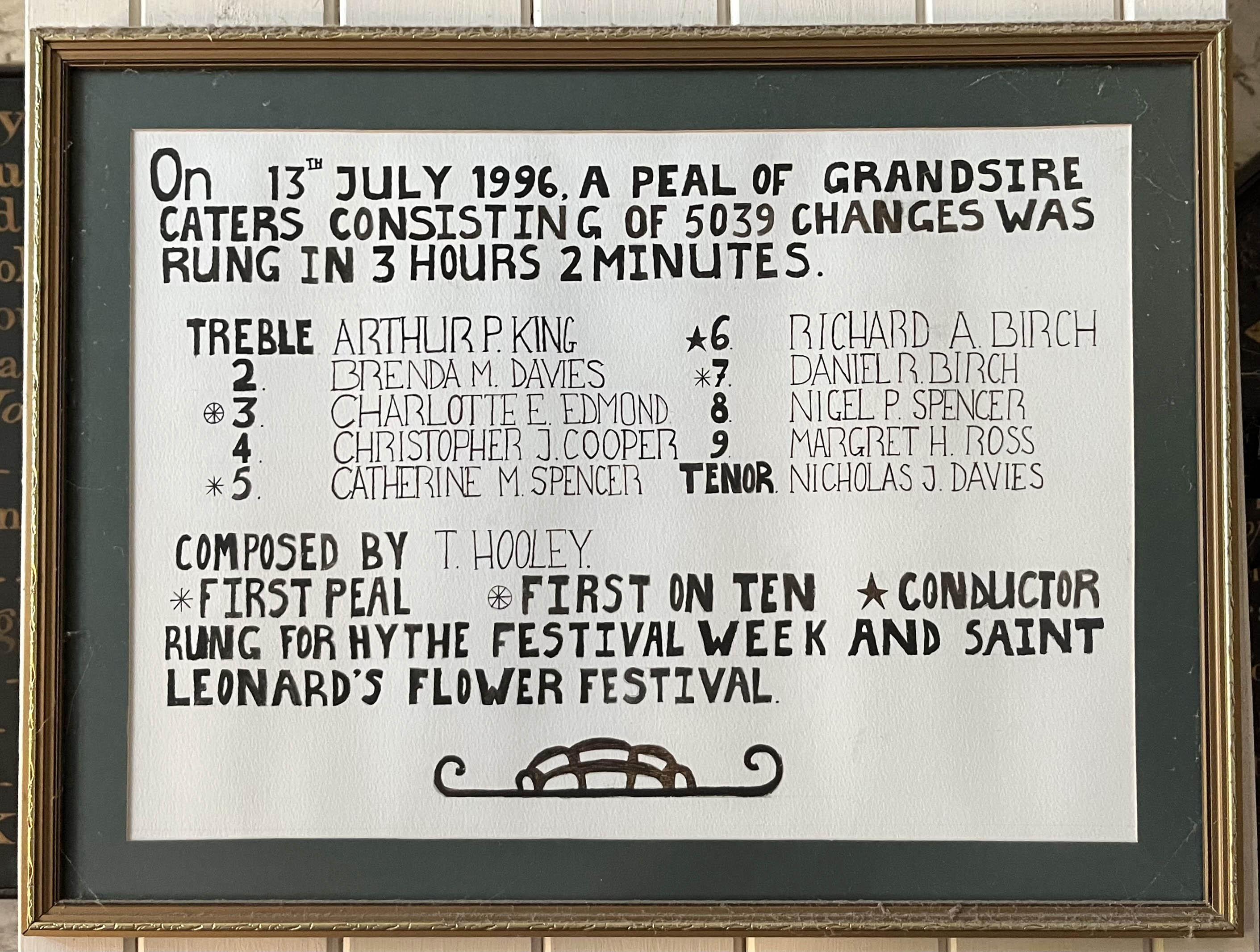
Photo: Richard Steele, 1 July 2025
Page updated: 29 May 2023